Can an L1 Align Their L2s Through Economic Incentives?





Key Takeaways
- •L1 blockchains can achieve economic alignment with L2 rollups through time-vested token grants combined with buy-back-and-burn mechanisms, where the exponential value accrual from burning can compensate for the linear decrease in token holdings over time.
- •The effectiveness of token grant alignment depends critically on having revenue recycling mechanisms like buy-back-and-burn that ensure L1 revenue translates to value accrual for token holders, creating stronger incentives than direct revenue sharing alone.
- •In multi-L2 ecosystems, individual L2s benefit when others remain aligned with the L1, but each faces temptation to deviate for individual gain, requiring coordination mechanisms to maintain the collectively optimal equilibrium where all L2s share revenue fairly.
Can an L1 align their L2's through economic incentives?
Making sure the interests of an L2's and applications are alinged with those of the L1 blockchain over which they are built, is a dificult challenge faced faced by multiple web3 ecosystems. Ultimately the solution is multifaceted.
Alignment is built through shared infrastructure, shared goals and ecosystem culture, mutual service dependencies where different players rely on using each other's services.
Alignment through simple economic incentives can play a significan role as well, and has been utilized, for example, in the form of airdrops for early participants, token rewards for aligned behavior, a well as slashing staked funds for malicious actions.
In this article we try to answer the question How much alignment can be obtained by simply giving L1 tokens to the L2, and vesting the reward over time?
We quantify the conditions under which alignment through economic rewards is possible, provide the formalism to understand when this type of token grants can be an effective alignment investment for an L1.
A purely economic model of alignment
Can an L1 align an L2, simply by giving them a certain amount of L1 token?
At first order this makes sense, given that once they are in possession of L1 token, it is in their best interest that that token also accrues value.
Let's dig deeper into this question by phrasing it in pure rational economic terms.
If there is a fixed amount of value generated by the ecosystem: for example, a total amount of revenue R is generated by selling services to paying users, Is it the L2's best strategy to attempt to keep all that revenue for itself? or would they be better off sharing some amount of revenue with the L1?
Let's look at the two extreme cases, which seem rather trivial, but are useful to understand:
Maximally non-aligned L2 Suppose in a given period of time, a total amount of revenue R is generated between the L1 and L2. Of that, R₁ will go to the L1, and R₂ will go to the L2, such that R = R₁ + R₂.
Suppose the L1 has a token, with circulating supply S₁, and the L2 has a token with circulating supply S₂.
In our model, revenue distribution is such that if one entity owns all of the supply of one token, then they will receive the entirety of the revenue generated.
The tokens themselves also have value, and they can be sold. If one holds σ₁ of the A tokens, with σ₁ ≤ S₁, then the market value of that token at time t is given by Vₜ(σ₁), and V(S₁) is the market cap of the token, so we have,
In the maximally non-aligned case, there is one entity who owns the entirety of the supply S₂, and owns nothing of the supply S₁. After the time period where revenue is generated, the entity's wealth will grow as,
That is, it is obviously in their best interest that the L2 makes all the revenue. Their wealth would be maximized by R₂ = R and R₁ = 0.
Maximally aligned case
In the maximally aligned case, one single entity owns the entirety of the supply S₁ and S₂. That is, the L1 could theoretically maximally align the L2, by giving them the entirety of L1's supply. This is of course a silly proposition, but it let's us understand what are the edge cases. In this case, after the period of time where revenue is made, the entity's wealth will grow to
In this case we call it maximally aligned, because the entity is completely indifferent about whether the L1 or the L2 obtain more revenue, their only interest is to maximize the total revenue created accross the ecosystem.
What lies in between
The much more interesting cases we want to analyze in this article occur when the L1 gives the L2, some fraction σ₁ of their circulating supply.
Now there are different ways this token can be given, for example:
- It can be given as a lump sump at the start without any restrictions.
- It can be vested over time to the L2.
- It can be minted to the L2 over time as they submit proofs that they have improved some KPI for the L1.
- It can be given to the L2, but with conditional unlocking, where the L2 can only retrieve and sell their token once certain L1 metrics are met (For example: can only sell the token once the L1 Market cap surpases x).
These can lead to a scenario for the L2 where their utility is somewhere between the maximally non-aligned and the maximally aligned case.
We explore here quantitatively, how much alignment can actually be bought through through this strategy? And how can the L1 get the most alignment out of the L2, for a fixed amount of token σ₁?
The method 1. for obtaining alignment from the list above is not very promising, as the L2 could simply sell its L1 token right away, so alignment is not guaranteed.
In the next sections we explore in details how much alignment can be secured through method 2.
We leave a deeper study of methods 3 and 4 for a future blogpost.
Alignment through time-vested token grants
For the L1 to align the L2, it can grant the L2 an amount of its own token, σ₁. The power of this strategy depends entirely on how value from the L1's revenue, R₁, flows to its token holders.
If the L1 practices direct revenue share, it distributes a portion of R₁ to token holders. The L2 receives a linear in time benefit proportional to R₁, but its incentive to maximize its own revenue, R_B, which it receives in full, will likely remain stronger.
A more powerful mechanism is the buy-back-and-burn. Here, the L1 uses its revenue to buy its own tokens on the open market and permanently destroys them. This reduces the total supply, making each remaining token---including those held by the L2---more valuable. The effect is multiplicative; the value of the L2's holdings can grow exponentially with the L1's sustained success.
To estimate what would be the effect of buy-back-and-burn, we can use a simple model, where we assume, the action of burning token does not change the Market cap of the L1. That is, the only value accrual that occurs from burning, is that the remaining tokens now represent a larger fraction of the market cap. This is a conservative assumption, where we are only considering that burning reduces the supply of tokens while not affecting the demand. In reality public reactions to buy-back-and burning could be more complex than that, for instance a high burn rate may inspire optimism that can increase the demand further, but these are higher-order, more speculative effects that we don't consider here.
We can represent this assumption as
from which it follows,
If after one time period, R₁ in revenue was used to buy and burn token.
Now suppose at time t, the L2 owns the entire value of the circulating supply S₂, but over M time periods, the amount σ₁ of L1 tokens will be vested linearly to them. That is, every time period until t+M, an amount σ₁/M is released, which we conservatively assume they will sell right away.
Now, combining the effects that the L2 is selling L1 tokens immediately as they become available, but the value of each L1 token is increasing over time according to the buy-back-and-burn dynamc, we can derive the total wealth of the L2 after N time periods, with N < M, as
This compounding growth creates a much stronger pull towards alignment. The upside from helping the L1 succeed becomes far more significant and harder to ignore, as the contribution to their wealth from revenue R₁ grows exponentially over time.
Adding some plots can help us get some intuitive understanding of this formula. In the following, we will plot the total wealth of the L2 after N time periods, for a fixed M, fixed total revenue R, and fixed ratio Vₜ(S₂)/Vₜ(σ₁), as a function of R₁.
That is, in a non-aligned case, we expect the function wₜ₊ₙ(R₁) to be monotonically decreasing with R₁. That is, non-alignment is represented by the L2 always being better off with smaller values of R₁
We can see this for example with the choice of parameters:
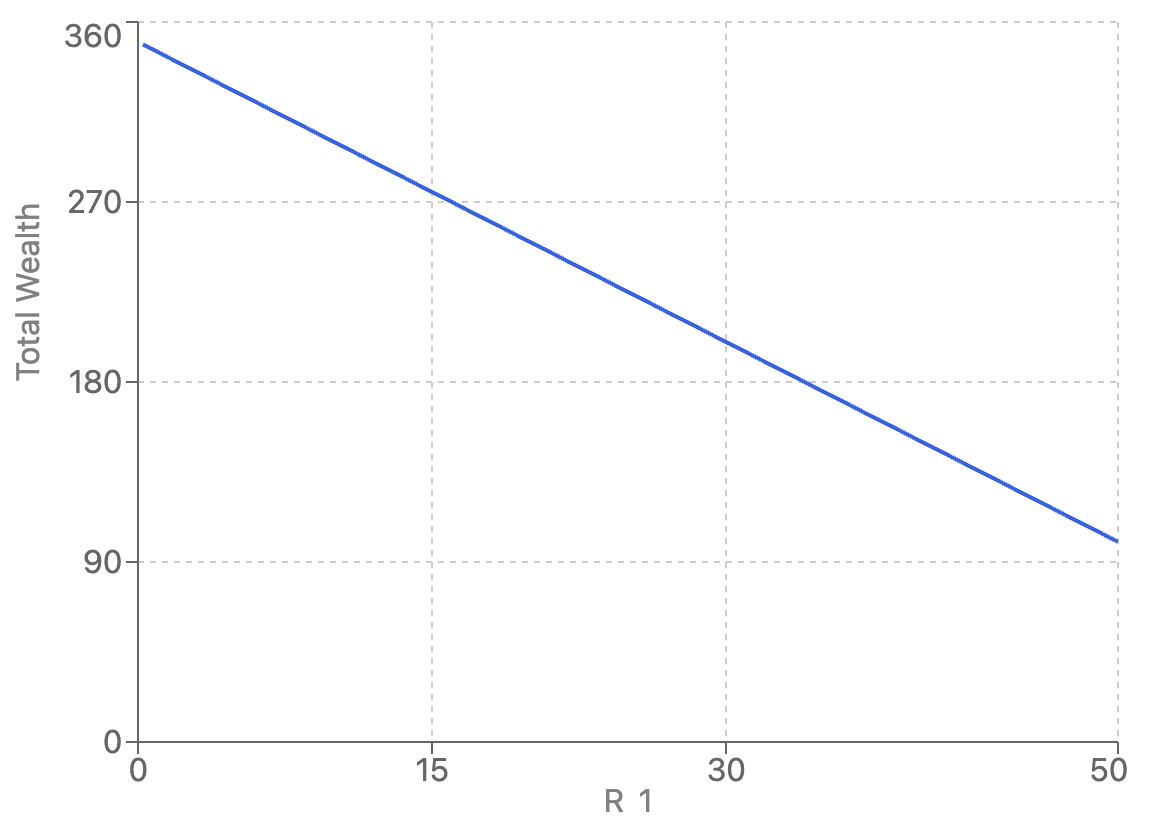
We see non-alignment (monotonically decreasing wealth as a function of R₁) with parameter choices M = 375, R = 50, Vₜ(S₂)/Vₜ(σ₁) = 100, and we are looking at early early times in the vesting period, N = 5.
On the contrary, alignment starts to turn around as we wait later into the vesting period, one can see that larger values of R₁ start becoming more favorable,
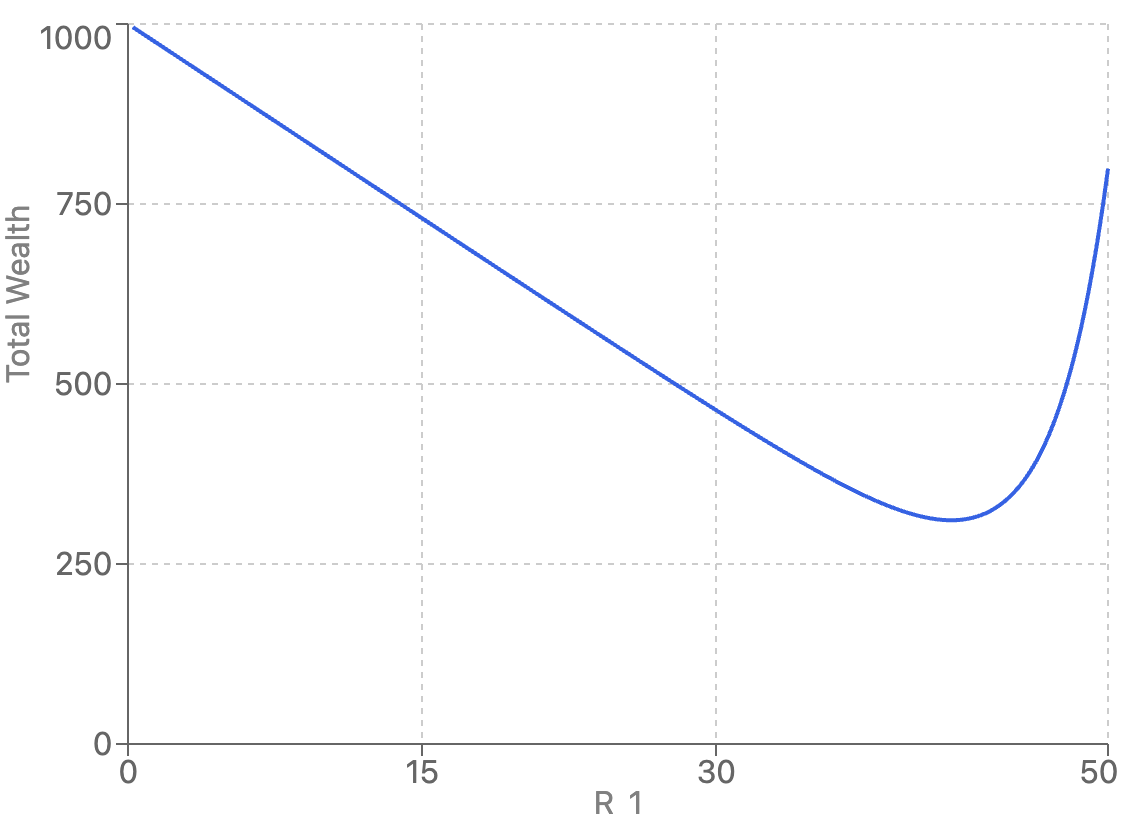
We see alignment starts to emerge for higher values of R₁, as time increases, N = 18 here.
The numbers chosen here are rather arbitrary, just to showcase the change in alignment behavior that can occur. You can explore different parameter combinations using the interactive calculator below:
Interactive L1-L2 Alignment Calculator
Formula:
VS_B + N×(R-R_A) + (1/M) × [1 - (1/(1-R_A/100))^N] / [1 - (1/(1-R_A/100))]
Current Parameters:
R_A (L1 revenue) ranges from 0 to 50.0
L2 Wealth vs L1 Revenue (R_A)
Note: The plot shows L2 wealth as L1 revenue (R_A) varies from 0 to R. Values near R_A = 100 may approach infinity due to the denominator approaching zero.
The main take away is that an L2 is more willing to share revenue with the L1, if there is a mechanism in place (such as buy back and burn), that ensures that that revenue will eventually lead back to value accrual for the L1.
Crucially, the mathematical insight that makes alignment possible as seen in the last figure, is that while if we and assume that with linearly vested rewards are sold immediately by the L2, that would mean that total alignment over time is linearly decreasing over time. However, the buy back and burn component means that, even though the total stake the L2 holds of L1 token is linearly decreasing over time, the value of the remaining piece is growing exponentially.
The linear decrease in alignment being compensated by an exponential increase in alignment is what leads to the existance of a viable window of parameters, where alignment can be sustained, as seen in the last figure.
Is coordinating alignment accross Multiple L2's possible?
The question of obtaining L2 alignment is more interesting when there are multiple L2's, and different winning strategies can emerge.
Suppose now there are n L2's, and the L1 gives the i-th L2 an amount σ₁ⁱ of L1 token, vested over M time periods.
The wealth of the i-th L2 over N periods will grow as,
but now the total revenue R is split amongst all L2's, such that,
While in the case with one L2, there exist configuration where it would be rational for the L2 to try to keep all the revenue, it is clear in the n L2's case, that each L2 would be better off if the rest of the L2's were aligned.
In the case with many L2's then the solution with maximum utility for all agents may be one where all of the L2's agree to be aligned, and fairly split their revenue with the L1.
This maximum utility solution, however, is not necessarily an equilibrium point, as each individual L2 may attempt to improve their individual wealth by not being aligned, but reaping the benefits of everyone else being aligned.
Ideally, we would need a mechanism through which all L2's can coordinate to act in their collective best interest.
Alignment through time vesting coupled with buy-back and burn
A buy back and burn is a proven mechanism to deliver value back to all token holders, and those who continue to hold will continue to benefit exponentially over time. Holding this token would mean that it is in your best interest that the token keep accruing value.
The problem is then, how does an L1 make sure that the L2 keep holding the token, as the value accrual argument only works if they continue to hold.
This is why the winning strategy is to couple buy back and burn with time-vested grant mechanisms, which ensure the L1 will get the benefits of value accrual, and therefore be invested in this.
These are only a few particularly simple tools in the L1/L2 alignment box, which are better used in combination with different alignment techniques.
Discuss This Article With AI
Get instant analysis and insights from leading AI assistants
How We Can Help
Interested in similar solutions for your project? Explore our related services: