EconoLens: Conversational Filecoin Economic Analysis





EconoLens: Conversational Filecoin Economic Analysis

Introduction
Storage providers planning hardware investments need to understand ROI trajectories. Token holders analyzing long-term tokenomics want to see how circulating supply will evolve over the next 2 years. Developers exploring economic simulation need access to historical network data and forecast capabilities. All of these questions currently require spreadsheet analysis or custom modeling.
EconoLens makes Filecoin economic analysis accessible through a conversational interface. You ask questions in plain English—"What will storage provider ROI be over the next year?"—and receive both a clear explanation and data-backed forecasts with interactive charts.
The tool combines DeepSeek V3 with MechaFIL, our differentiable digital twin of the Filecoin economy. Behind the scenes, MechaFIL models supply dynamics, reward schedules, lockup mechanics, and storage provider economics as a differentiable system, enabling scenario analysis across configurable parameters like onboarding rate, renewal rate, and FIL+ verified deal rate. EconoLens wraps this modeling power in a chat interface that translates natural language queries into precise economic forecasts.
Currently in testing phase, EconoLens is available at cryptoeconlab.com/econolens with 2 free queries for anonymous users and unlimited access for authenticated users.
Use Cases
EconoLens serves multiple user types through its question-forecast-analyze workflow:
Storage providers can query ROI forecasts across different hardware configurations and growth scenarios. A provider might ask: "What will 1-year ROI be with 5 PiB/day onboarding?" and receive a forecast showing projected returns, sensitivity to renewal rates, and comparison against historical performance. Multi-scenario queries enable parameter sensitivity analysis—"Show me ROI at 80% vs 90% renewal rates"—to inform hardware sizing and risk management decisions.
Token holders and researchers use the tool to understand supply dynamics and tokenomics evolution. Queries like "How will circulating supply change over the next 2 years?" or "What's the current network locked vs circulating ratio?" return historical data with interactive charts showing trends and projections. These insights help evaluate long-term token value drivers, understand emission mechanics, and assess lockup schedule impacts on circulating supply.
Protocol researchers and developers leverage EconoLens for counterfactual analysis. "What would happen to network power if onboarding increased by 50%?" runs simulations showing cascading effects on storage power, QAP (Quality-Adjusted Power), and reward rates. "How does FIL+ rate affect circulating supply?" compares verified deal fractions from 50% to 95%, showing impacts on inflation dynamics and storage provider revenue models.
Each query returns both natural language explanations and interactive visualizations. Forecasts include key metrics (starting/ending values, percentage changes, weekly data points) that users can explore through hover tooltips and download as CSV.
How It Works
EconoLens architecture combines three components: a conversational AI layer, an economic modeling engine, and a tool orchestration system.
The conversational layer uses DeepSeek V3, which processes natural language queries and decides when to invoke economic tools. When you ask "What will storage provider ROI be next year?", the AI understands this as a simulation request with a 365-day forecast horizon. For historical queries like "What's the current network state?", it retrieves data rather than running forecasts.
The economic modeling engine is MechaFIL, our differentiable digital twin of the Filecoin economy. Unlike static spreadsheets or rule-based models, MechaFIL represents Filecoin's tokenomics as a system of differential equations. This means it can compute how changes in one parameter cascade through the entire network: increasing onboarding rates affects network power, which influences quality-adjusted power, which determines reward distribution. All of these dynamics are mathematically connected rather than hardcoded relationships.
The orchestration layer manages the conversation flow. EconoLens follows a three-step pattern: understand the question, invoke the appropriate tool (simulation or historical data), then interpret results in plain language. For simulations, you see the forecast displayed as an interactive chart with key metrics highlighted. For historical queries, you get both data and AI-generated insights about trends and patterns.
This architecture enables what-if analysis without requiring users to build models themselves. You don't need to know which parameters matter or how they interact—EconoLens handles that translation between natural language and economic modeling.
Example Queries
Query 1: ROI Forecast
"What will storage provider ROI be over the next year?"
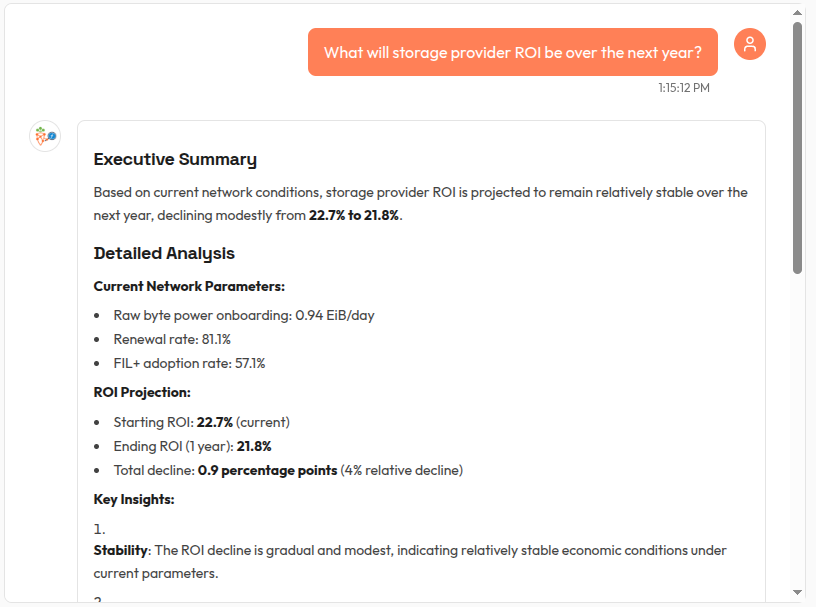
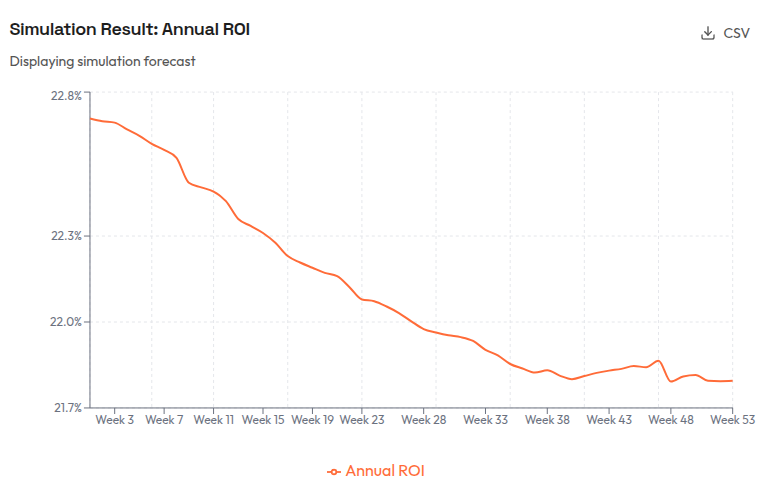
Response: EconoLens runs a 365-day simulation with default network parameters. The forecast shows 1-year sector ROI projected at X%, with weekly data points displayed in an interactive chart. AI explanation notes that current renewal rates suggest Y% of sectors will extend, and that increased FIL+ adoption would improve margins. You can explore sensitivity by asking follow-ups like "Show me ROI at 90% renewal rate."
Query 2: Supply Analysis
"How will FIL circulating supply change over the next 2 years?"
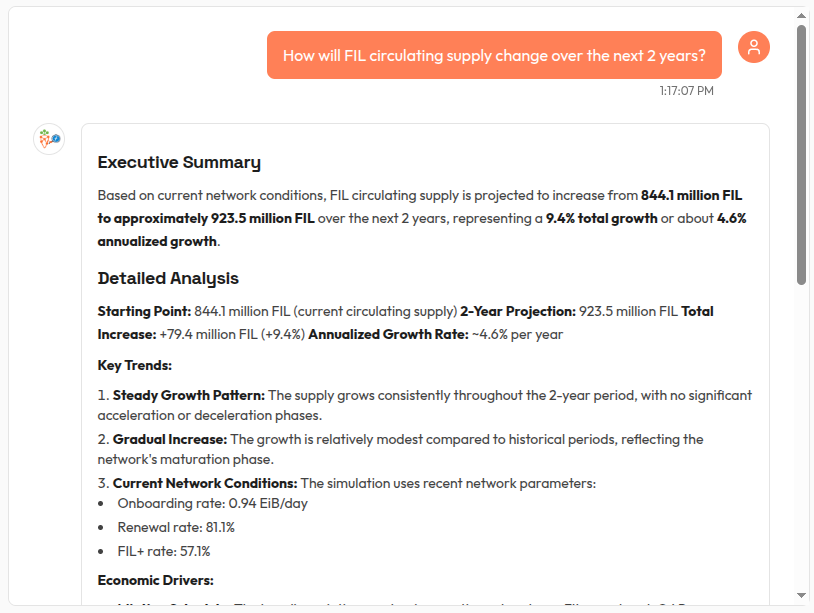
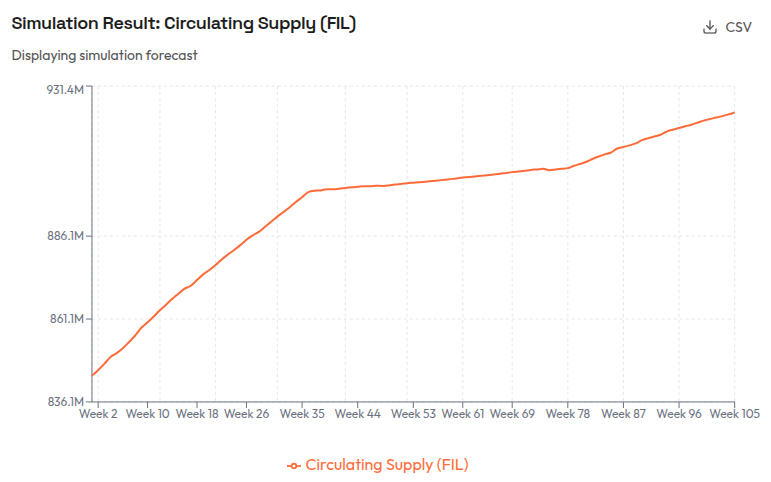
Response: EconoLens simulates 730 days of network operation, showing circulating supply trajectory. The chart illustrates emission schedule impacts, lockup expirations, and burn dynamics. AI highlights key inflection points: when initial vesting cliffs occur, when supply growth rate peaks, and what the projected 2-year supply cap is. You can download the forecast as CSV for your own modeling.
Query 3: Current Network State
"What's the current state of the Filecoin network?"
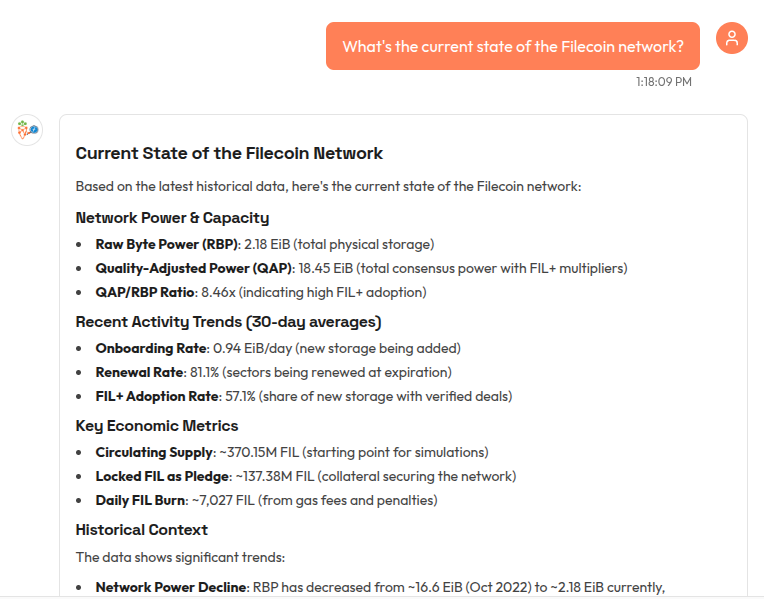
Response: EconoLens retrieves historical data and presents key metrics: current network RBPs (Raw Byte Power), QAP (Quality-Adjusted Power), day rewards per sector, FIL+ rate, and circulating vs locked supply. The AI provides context: "Network power has grown Z% over the past 90 days, driven by increased onboarding. Renewal rate is stable at W%, and FIL+ adoption has increased from A% to B% this quarter."
Each query includes interactive charts where you can hover to see specific values, zoom into time ranges, and compare multiple scenarios by asking follow-up questions. The chat interface maintains conversation context, so you can refine analyses without restating assumptions.
Testing Phase and Feedback
EconoLens is currently in a pilot testing phase. We're interested in feedback from the community to help improve the tool and identify valuable use cases.
[Screenshot: Feedback form showing rating scale and comment field]
Tell us what worked well, what could be improved, and which analyses would be valuable for your work. Contact us at advisory@cel.build with your thoughts.
Get Started
Try EconoLens at cryptoeconlab.com/econolens. Anonymous users receive 2 free queries; sign in with Google for unlimited access.
If you're building similar tools: EconoLens demonstrates how to combine large language models with economic simulation engines. We provide consulting on integrating MechaFIL and other digital twins with AI assistants, building custom economic analysis tools for your protocol, and designing conversational interfaces for complex modeling. Contact us to discuss your project.
If you're interested in MechaFIL: The underlying digital twin is available as open-source software at github.com/celtd/mechafil-jax. You can run it locally, integrate with your own AI assistant, or explore Filecoin tokenomics through its API.
If you want to learn more: Explore our other work on Filecoin economics, including analysis of FIL-RetroPGF rounds, tokenomics audits, and economic modeling tools. Visit our insights page for more research and analysis.
This tool demonstrates CryptoEconLab's approach to making complex economic systems accessible through AI-powered interfaces. For more insights on crypto economics and protocol design, explore our other publications and case studies.
Discuss This Article With AI
Get instant analysis and insights from leading AI assistants
How We Can Help
Interested in similar solutions for your project? Explore our related services: