A Deep Dive into FIL-RetroPGF-3 Results





A Deep Dive into FIL-RetroPGF-3 Results

The Filecoin network recognizes that public goods are essential to a healthy ecosystem. To support these often underfunded efforts, Filecoin runs a RetroPGF program, initially modeled after the Optimism RetroPGF, in which public goods are funded based on a retroactive impact assessment by badgeholders.
FIL-RetroPGF-3 is the third instance of the RetroPGF effort in Filecoin. In it, projects were asked to apply under one of the following categories: Infrastructure & Dependencies, Tooling & Utilities, Education & Outreach, Protocol R&D, Governance, and Product & UX. Badgeholders then voted to distribute to these projects 510,000k FIL donated by Holon Global, Filecoin Foundation and Protocol Labs, based on their assessment of retroactive impact that projects provided to the Filecoin ecosystem.
This document deep-dives into the funding allocated to projects in FIL-RetroPGF-3. We begin by summarizing the results of Round 3, then compare insights across rounds.
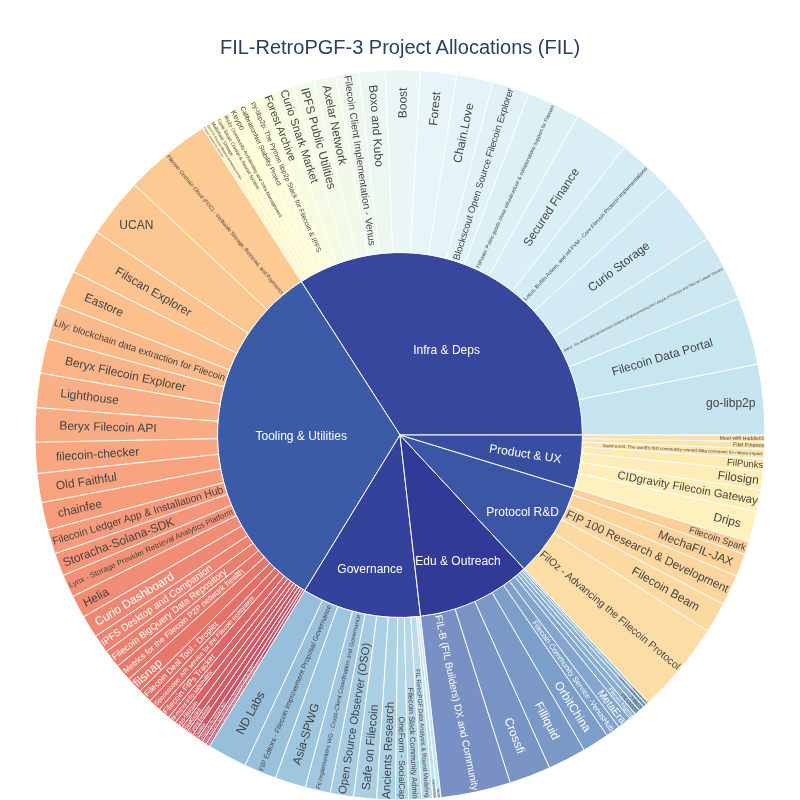
Project Funding Breakdown
The top 5 projects to receive funding were:
- FilOz - Advancing the Filecoin Protocol — 20709.04 FIL
- Filecoin Onchain Cloud (FOC) - Verifiable Storage, Retrieval, and Payments — 19762.72 FIL
- go-libp2p — 15884.55 FIL
- FIL-B (FIL Builders) DX and Community — 15761.05 FIL
- Filecoin Data Portal — 15220.78 FIL
These projects captured 17.1% of the total funding available in Round 3.
The mean and median projects were allocated 5604.40 FIL and 4959.67 FIL, respectively, and the top-scoring project was allocated 20709.04 FIL.
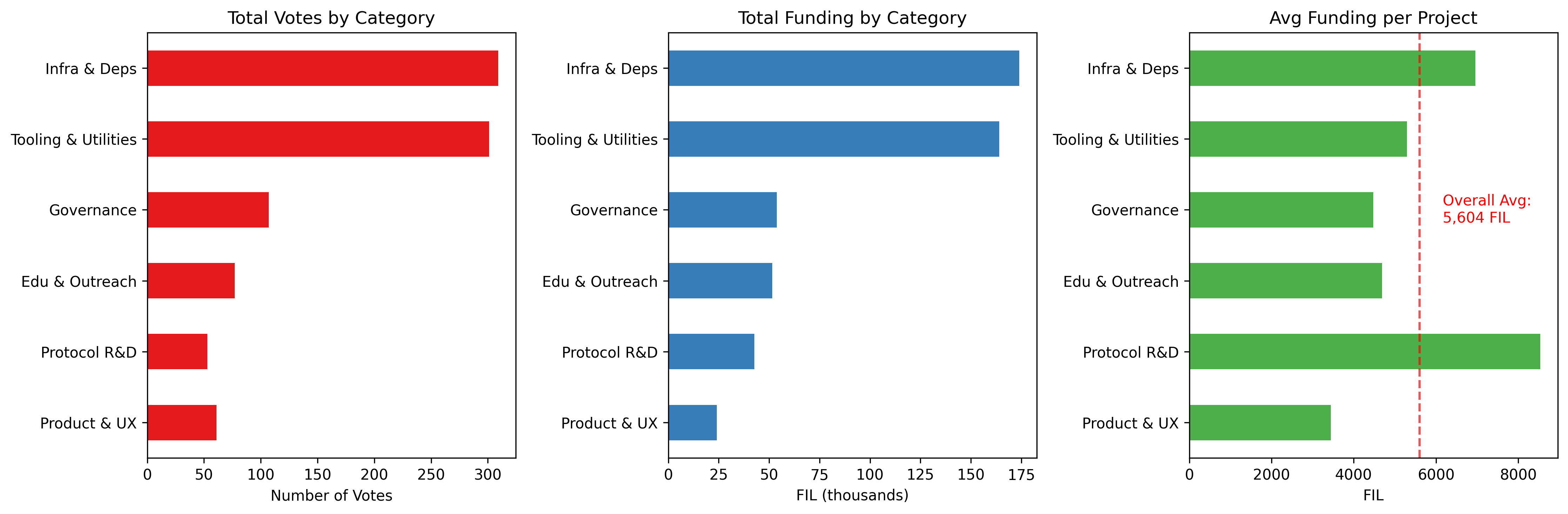
Fig 2 shows how votes and funding were allocated across the different categories. Projects in certain categories received funding above average, while others received less than average funding per project.
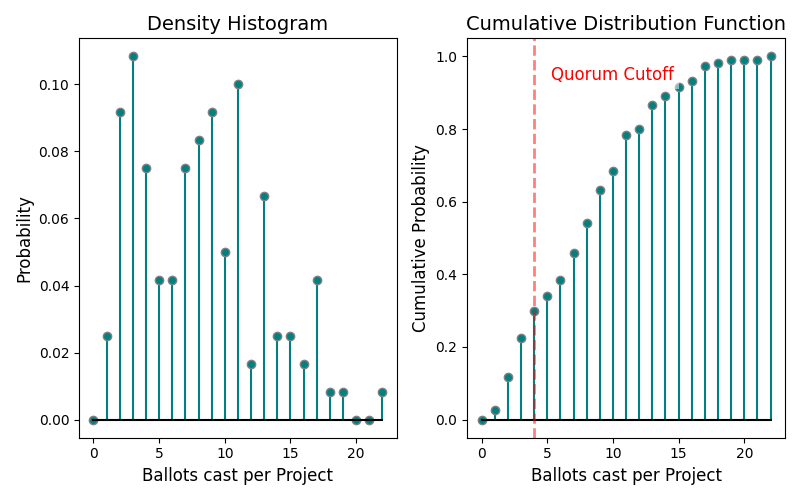
Ballots Cast
Fig 3 shows information about badgeholder voting patterns. The most common number of ballots a project received was 3, and the minimum was 1. 77.5% of projects that submitted applications were eligible for funding because they met quorum requirements (at least 4 ballots cast). 2 projects were eliminated due to the minimum funding cutoff of 500 FIL.
The following figure (Fig 4) shows the ballots cast by the badgeholders for each project. It is sorted by the number of ballots each project received. The projects that received the most ballots were:
- go-libp2p — 22 votes
- Filscan Explorer — 19 votes
- FilOz - Advancing the Filecoin Protocol — 18 votes
- Blockscout Open Source Explorer — 17 votes
- Drips — 17 votes
- Curio — 17 votes
- drand - the distributed randomness beacon project powering the League of Entropy and Filecoin Leader Election — 17 votes
- Chain.Love — 17 votes
Note that the alignment between top-funded and top-voted projects indicates strong consensus across badgeholders in identifying projects most impactful to the Filecoin ecosystem.
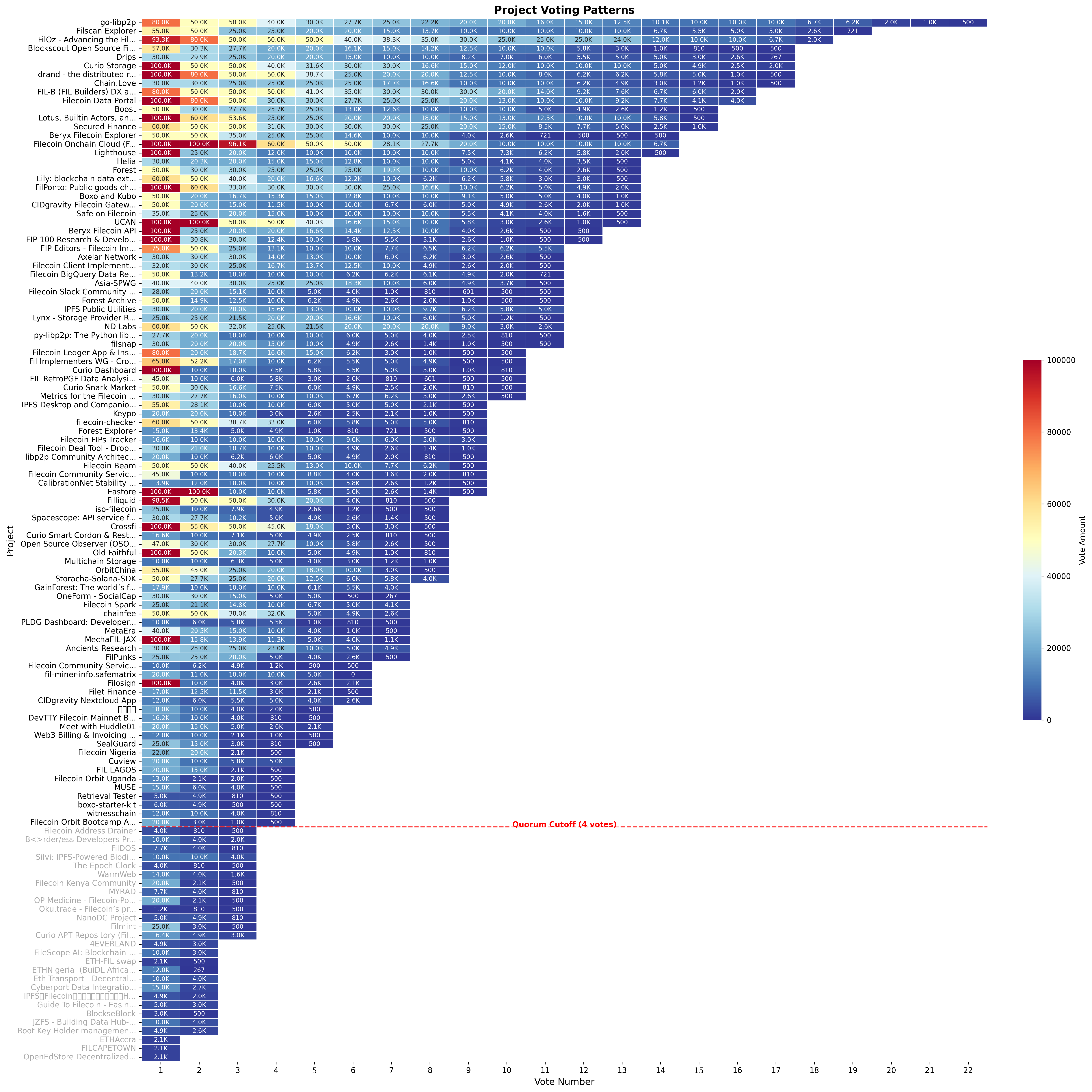
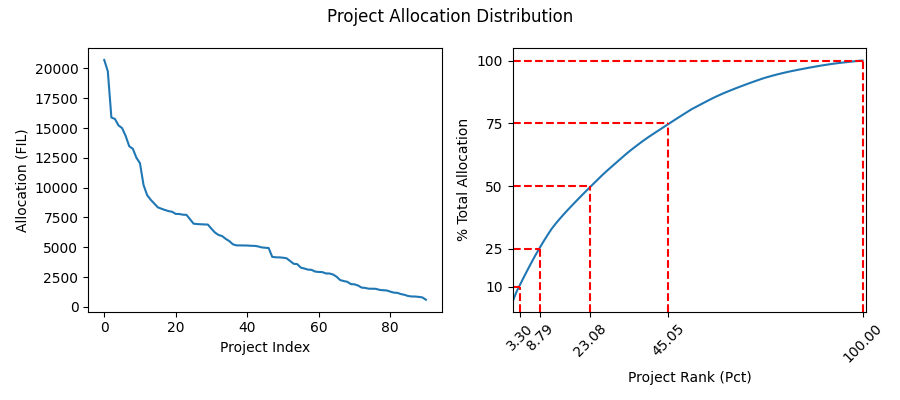
Fig 5A shows how the funding was distributed across the different projects. Fig 5b shows the rank ordering of projects and the total percentage of funding they received. The Top 3.30% of projects received 10% of the total allocation, the top 8.79% of projects received 25% of the total allocation, the top 24.18% of projects received 50% of the total funding, the top 46.15% of projects received 75% of the total funding. Both of these represent a power law distribution with a heavy tail of funds to projects, indicating that badgeholders were very discerning in their funding allocation decisions.
Badgeholder Voting Patterns
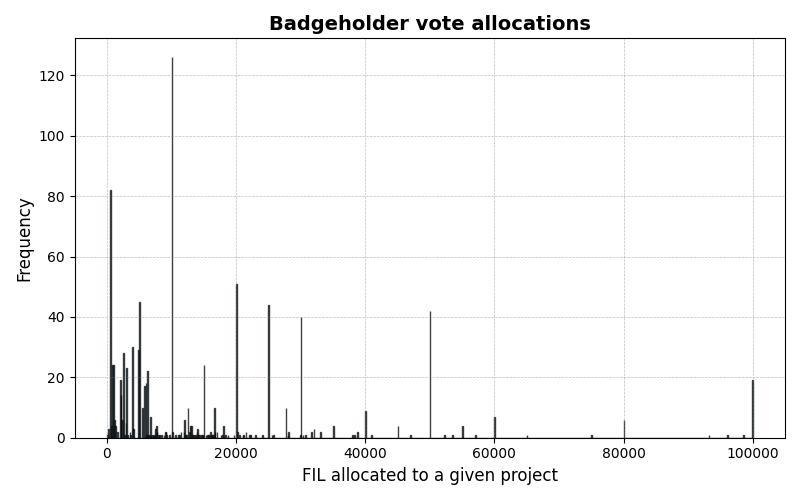
In FIL-RetroPGF-3, badgeholders were instructed to distribute up to 510,000k FIL across all eligible projects. Fig 6 shows a histogram of the allocation of funds across all projects. The most common amount of funding allocated by badgeholders to projects was 10000 FIL, and the second most common was 500 FIL.
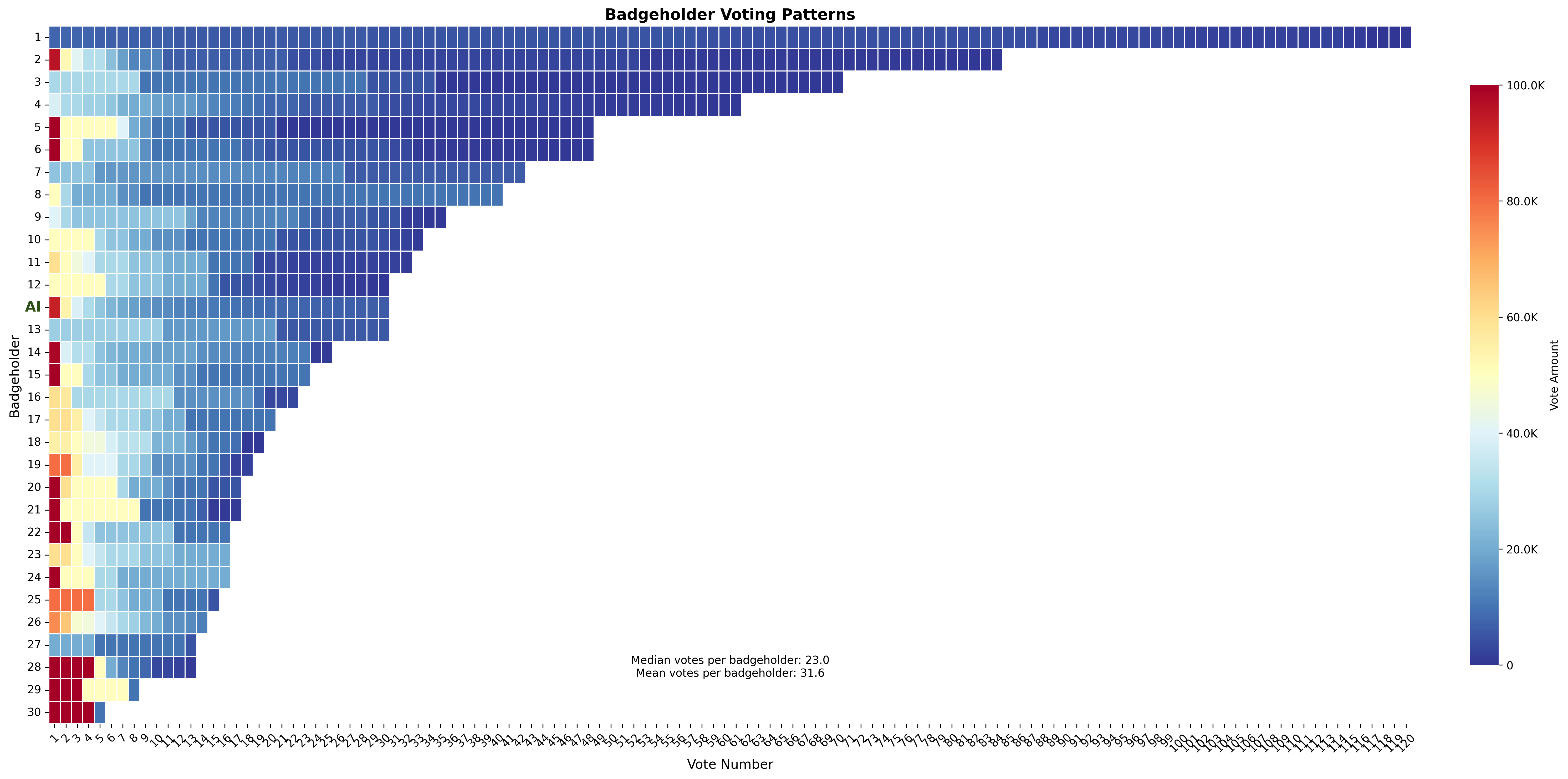
To examine badgeholder voting patterns in more detail, let us define the temperature of a badgeholder to be related to the number of ballots cast. A cold badgeholder distributes their votes across many ballots. A hot badgeholder concentrates their votes to a few projects. Using this framework, we can rank badgeholders by their "temperature" and observe how they voted across the various projects. This is shown in Fig 7 — the top of the chart shows the coldest badgeholder, and the bottom of the chart shows the hottest badgeholder.
How reliable is the size of the badgeholder set?
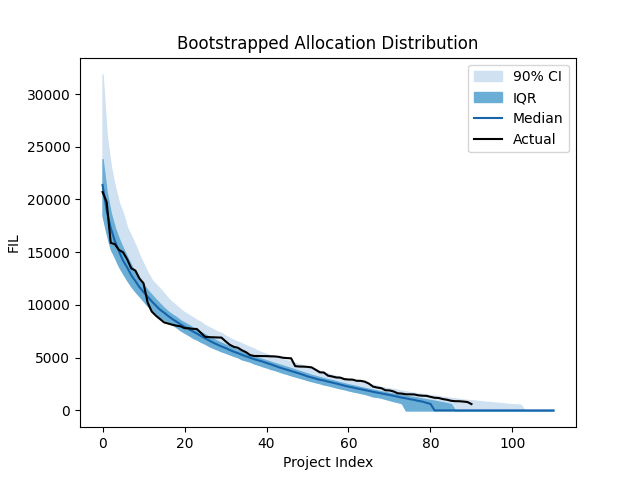
How confident are we in the distribution of funds indicated in Fig 5? We performed a bootstrap analysis by selecting 1000 possible subsets of ballots cast by badgeholders. We then compute the confidence intervals of these distributions and overlay them with the actual funds distribution. This is shown below in Fig 8. The IQR indicates that the number of badgeholders is reasonable at estimating the true signal, since the confidence intervals shown from different partitions of the badgeholders are not very dispersed.
Counterfactuals
Considering the presented results, we now perform counterfactual analysis to understand how the allocation distribution would have changed had different scoring rules been applied.
Quorum Size
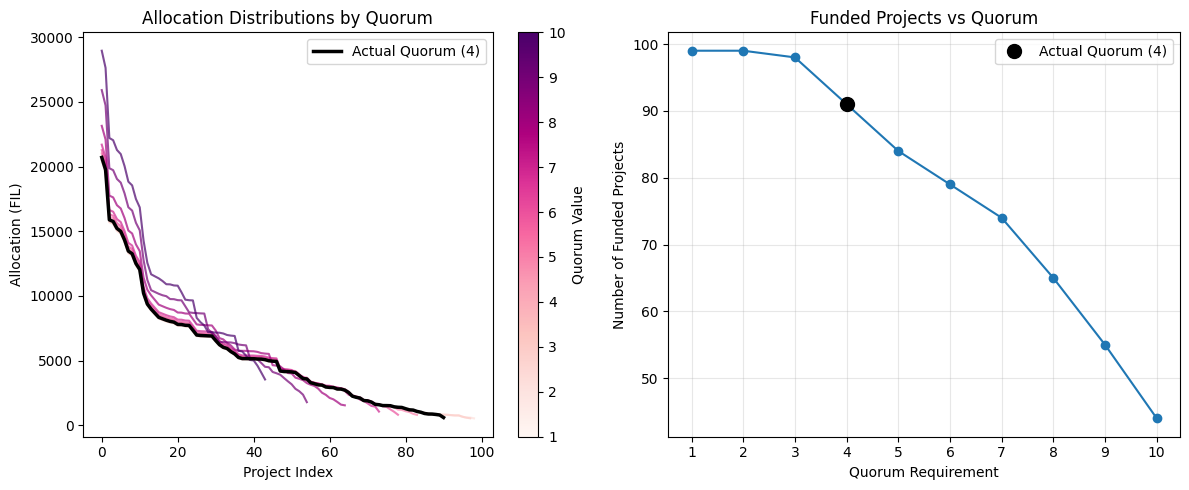
If quorum was a different size, what would the distribution of funds have been and how many projects would have been funded? Fig 9 shows that there is a sustained but roughly linearly decreasing relationship in the number of projects that are funded as quorum increases. As quorum decreases, the distribution of funds is flattened, but note that regardless of the quorum value, the funds remain relatively exponentially distributed — this is a positive signal that badgeholders in general have been discerning in funding allocations.
Scoring Mechanism
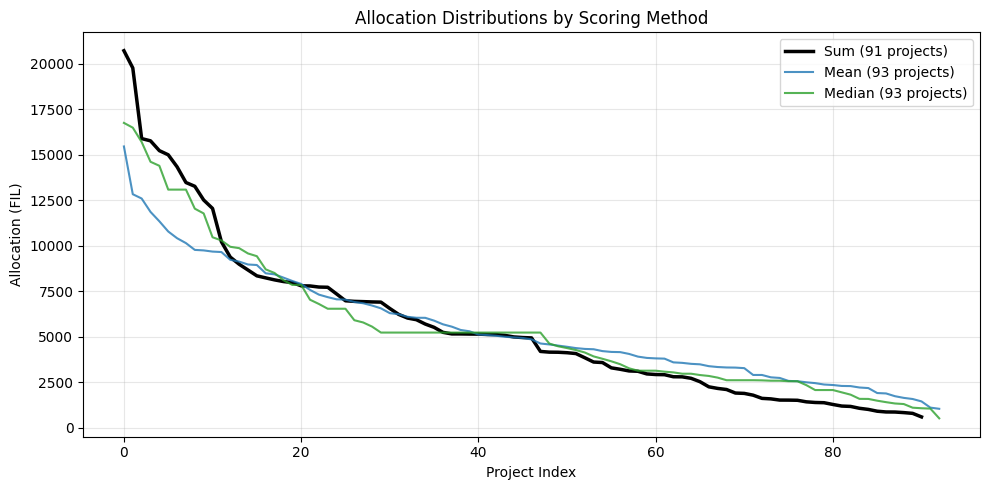
In FIL-RetroPGF-3, we used a sum scoring rule. How would the distribution of funds change had we used alternate scoring? Fig 10 shows how the funding distribution would have changed. We observe that the sum scoring rule provides a more power-law scoring distribution.
Hot/Cold Badgeholders
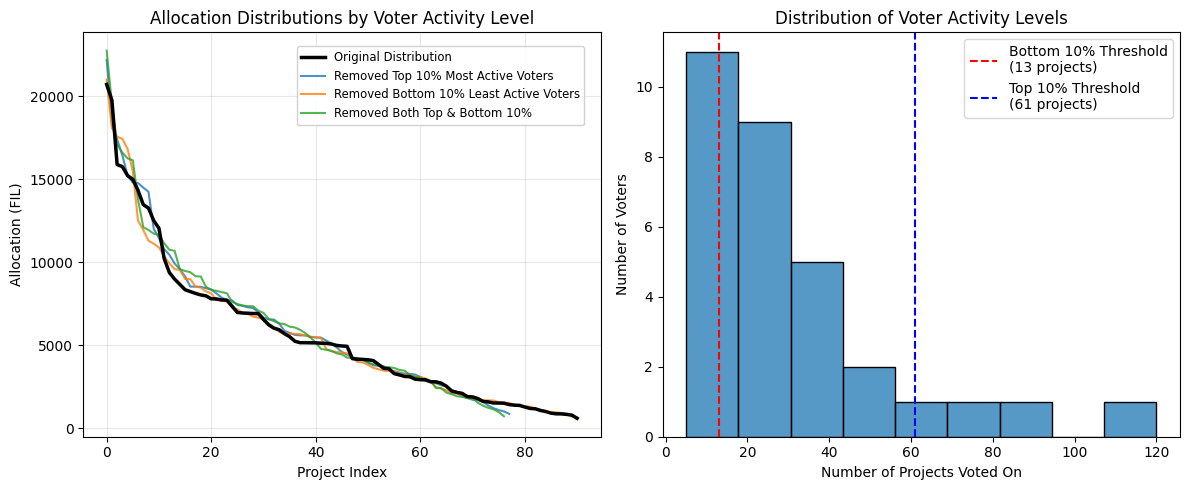
We previously introduced the concept of the temperature of a badgeholder. What if we remove the top 10% of cold badgeholders (voting diffusely) and the top 10% of hot badgeholders (voting concentratedly). How would the distribution of funds change? Fig 11 shows that had we removed both the most concentrated and most diffuse badgeholders, the funding distribution would be even more exponential than it already is. Removing only the hottest or coldest badgeholders independently would not have altered the distribution as much.
Impact of AI Badgeholder
FIL-RetroPGF-3 included an AI badgeholder that evaluated projects using a comprehensive assessment framework. This section compares the results with and without the AI badgeholder's participation.
Summary Comparison
| Metric | Without AI | With AI | Difference |
|---|---|---|---|
| Projects Funded | 91 | 91 | +0 |
| Projects Reached Quorum | 93 | 93 | +0 |
| Total Votes Cast | 950 | 980 | +30 |
Top Projects Comparison
| Rank | Without AI Badgeholder | Allocation (FIL) | With AI Badgeholder | Allocation (FIL) |
|---|---|---|---|---|
| 1 | Filecoin Onchain Cloud (FOC) | 20,461.54 | FilOz - Advancing the Filecoin Protocol | 20,709.04 |
| 2 | FilOz - Advancing the Filecoin Protocol | 18,142.61 | Filecoin Onchain Cloud (FOC) | 19,762.72 |
| 3 | FIL-B (FIL Builders) DX and Community | 16,049.88 | go-libp2p | 15,884.55 |
| 4 | go-libp2p | 15,659.49 | FIL-B (FIL Builders) DX and Community | 15,761.05 |
| 5 | Filecoin Data Portal | 15,432.30 | Filecoin Data Portal | 15,220.78 |
The inclusion of the AI badgeholder resulted in a reordering of the top projects, with FilOz moving to the top position and receiving the highest allocation. The same five projects remained in the top tier, though their relative rankings shifted.
Funding Distribution Impact
| Metric | Without AI | With AI | Difference |
|---|---|---|---|
| Mean Allocation | 5,604.40 FIL | 5,604.40 FIL | 0.00 FIL |
| Median Allocation | 4,815.74 FIL | 4,959.67 FIL | +143.93 FIL |
Conclusion
FIL-RetroPGF-3 allocated 510000 FIL to 91 projects. Badgeholders showed careful judgment and due diligence in their allocations. This is evidenced by a power-law distribution of funds in Fig 5A. Furthermore, the strong correlation between the top-scoring and top-voted projects indicates a clear alignment amongst badgeholders in identifying projects most impactful to the Filecoin ecosystem.
Looking at the category breakdown, we can see how funding was distributed across different areas of the ecosystem. The allocation reflects badgeholders' assessment of retroactive impact across infrastructure, tooling, education, protocol development, governance, and user experience.
There are several promising developments in the Filecoin ecosystem that will enable better tracking and assessment of project funding, which can lead to a more dynamic ecosystem. As we look forward to future rounds, these improvements will enable a more effective allocation of resources by the FIL-RetroPGF program across the ecosystem.
Thank you to the Filecoin ecosystem, nominators, applicants, software providers, donors and badgeholders for making FIL-RetroPGF-3 happen.
If you're interested in working with us on RetroPGF, tokenomics, mechanism design, quantitative modeling, or other related subjects, we'd love to hear from you. Please reach out to us at advisory@cel.build.
References
This research was conducted by CryptoEconLab as part of our ongoing work in governance mechanism design and RetroPGF analysis. For more insights on crypto economics and protocol design, explore our other publications and case studies.
Discuss This Article With AI
Get instant analysis and insights from leading AI assistants
How We Can Help
Interested in similar solutions for your project? Explore our related services: