Revnets: A Cryptoeconomic Analysis





Key Takeaways
- •Price floors rise mechanically with network activity, providing quantifiable downside protection
- •Tunable issuance schedules function as monetary policy, from stable business currencies to high-momentum launches
- •Guaranteed redemption access under all conditions through mathematical properties
- •Loan mechanisms remain solvent even under complete default scenarios
- •Seven immutable parameters determine all system dynamics—proper tuning at launch is critical
Quick Answer: Revnets are autonomous, tokenized financial structures built on immutable smart contracts that provide four mathematical guarantees: (1) cash-out prices that rise mechanically with network activity, (2) tunable issuance schedules functioning as monetary policy, (3) guaranteed access to capital under all conditions, and (4) loans that remain solvent even under complete default. They enable governance-free protocols where all system behavior is determined by seven immutable parameters set at deployment.
Revnets: A Cryptoeconomic Analysis
TL;DR
Revnets are autonomous, tokenized financial structures that route revenue inflows and cash-outs through immutable smart-contract rules, meaning no governance, and no intermediaries. Our cryptoeconomic analysis reveals four mathematical guarantees:
- Cash-out price that rise mechanically with network activity and that act as a price floor;
- Tunable issuance cuts that function as a monetary policy;
- Guaranteed access to capital under all conditions;
- Loans that remain solvent even under complete default.
For investors: Revnets provide predictable risk-reward corridors and quantifiable downside protection. Their price floors rise with real activity, not speculation, offering exposure to revenue growth with embedded solvency guarantees.
For founders: Success depends on intentional tuning of the parameters at launch. Seven immutable settings determine everything, from volatility and liquidity to growth rhythm and user behavior. These can produce radically different regimes, from high-momentum token launches to stable, revenue-backed business currencies. Once deployed, they can't be changed.
For everyone else: Revnets turn activity itself into value creation. Every purchase, redemption, or loan strengthens the system. They offer a credible, governance-free foundation for the next generation of open internet economies.
Full technical analysis available in our companion papers.
Introduction
At CryptoEconLab, we recently completed an extensive analysis of Revnets: autonomous networks that tokenize revenue through immutable smart contracts. Think of a Revnet as a digital vending machine: money goes in, tokens come out, and those tokens can later be redeemed for a share of the accumulated treasury or used as collateral for loans. All without governance votes or intermediaries.
Revnets are developed by the Juicebox protocol team as a way to create self-sustaining token economies tied to actual economic activity rather than speculation alone. The core premise is simple: deterministic rules set at deployment govern how tokens are issued, how value accumulates, and how participants can access liquidity. What makes them interesting is that these rules create measurable, predictable dynamics: a price floor that rises with activity, a ceiling that can be tuned for different use cases, and guaranteed solvency even under extreme conditions.
Our analysis combines mathematical modeling with computational simulations to understand how these systems behave under different parameter configurations. This post synthesizes our findings for two audiences: investors evaluating Revnet-based projects, and founders considering deploying them. Our full technical analysis is available in two companion papers: Cryptoeconomics of Revnets (the formal mathematical framework) and Revnet Parameters Analysis (computational experiments and design guidance).

How Revnets Work
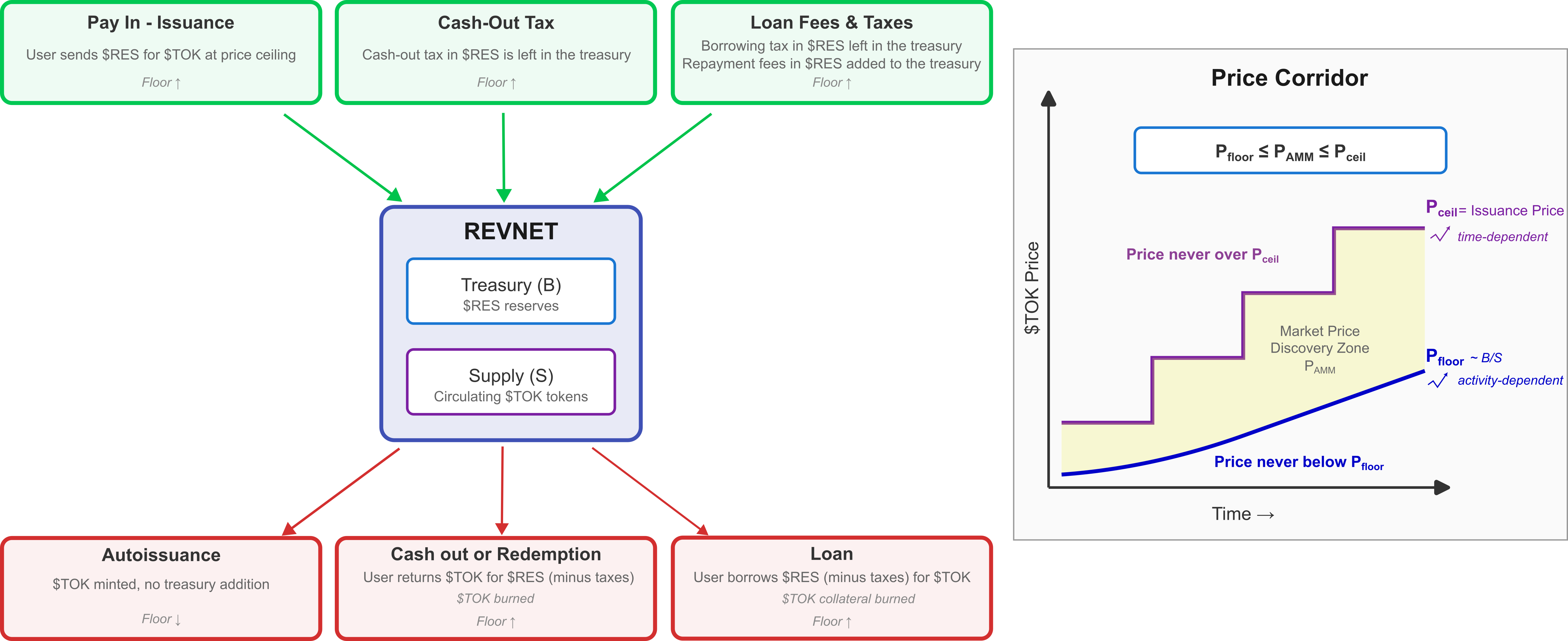
A Revnet operates through three core mechanisms:
Pay In (Issuance): Anyone can send reserve assets (e.g., USDC) to the Revnet contract. In return, they receive tokens at the current issuance price. The issuance price follows a predetermined schedule that can range from flat (no increases) to periodic step increases at configurable intervals. A configurable portion of each issuance can be automatically routed to designated recipients. For example, a business owner might set parameters so that 98% of tokens are routed to them as revenue share while 2% goes to customers as "cashback." The funds remain in the treasury, backing all outstanding tokens.
Cash Out (Redemption): Token holders can burn their tokens to reclaim a share of the treasury. The redemption follows a convex bonding curve: larger redemptions receive better per-token value, while a "cash-out tax" keeps a portion of each redemption in the treasury. This tax is crucial because it ensures that every exit increases the backing ratio (treasury ÷ supply) for remaining holders.
Borrow (Loans): Instead of exiting, holders can use tokens as collateral for loans. This allows them to access liquidity and to reinvest while maintaining exposure to future token appreciation. The borrowable amount is capped by the token's cash-out value, and collateral is burned at origination (not just locked). The system maintains solvency because borrowers receive less than their collateral's redemption value, creating an overcollateralization margin that depends on the cash-out tax. Even if all borrowers default, the system remains solvent because the burned collateral permanently reduces supply claims against the treasury.
Revnets operate in discrete stages, each defined by seven immutable parameters: stage start time, initial issuance price, price increase schedule, issuance frequency, revenue split percentage, cash-out tax rate, and any pre-authorized token releases. Once deployed, these parameters cannot be changed, which eliminates governance risk but places significant importance on initial calibration.
The Price Corridor
The parameters of each Revnet create a price corridor that constrains token value between two mathematically determined boundaries:
The Ceiling (Issuance Price): Set by the predetermined issuance schedule, this represents the maximum price at which anyone can acquire tokens directly from the protocol. The ceiling acts as a monetary policy lever: a flat ceiling creates stability, while a rising ceiling enables growth and scarcity dynamics.
The Floor (Backing Ratio): Calculated as treasury balance ÷ circulating supply, this represents the guaranteed minimum value that tokens can redeem. Unlike speculative tokens that can go to zero, every Revnet token is backed by real assets. This floor rises predictably as activity occurs: issuances above the floor add more treasury than supply, redemptions remove supply faster than treasury (due to the cash-out tax), and even loan defaults strengthen the floor by burning collateral.
Arbitrage Enforcement: Due to arbitrage, the secondary market price cannot escape this corridor. If the market price rises above the ceiling, traders will buy directly from the protocol and sell on the secondary market, pushing the price back down. If the price falls below the floor, traders will buy from the secondary market and redeem for treasury value, pushing the price back up. This creates a natural price discipline independent of speculation.
The corridor's width, meaning the gap between ceiling and floor, reflects the system's maturity and is determined by the immutable parameters set at deployment. For investors, this means quantifiable downside protection (the rising floor) and predictable dilution risk (the issuance schedule). For users, it means guaranteed exit liquidity at the floor price under all conditions.
Why Revnets?
Traditional token models face a recurring tension: how to create sustainable value accrual without relying purely on speculation or requiring continuous governance intervention. Most token systems address this through either centralized decision-making (where teams control supply, burning, staking yields) or decentralized governance (where token holders vote on economic parameters). Both approaches introduce risks: central points of failure, governance attacks, voter apathy, or misaligned incentives.
Revnets offer a third path: mechanistic value accrual through deterministic rules. Once deployed, a Revnet operates entirely autonomously. No one can mint extra tokens, change cash out terms, or alter economic parameters. Value accumulation is tied directly to usage through mathematical relationships rather than human decisions.
This determinism creates several distinctive properties:
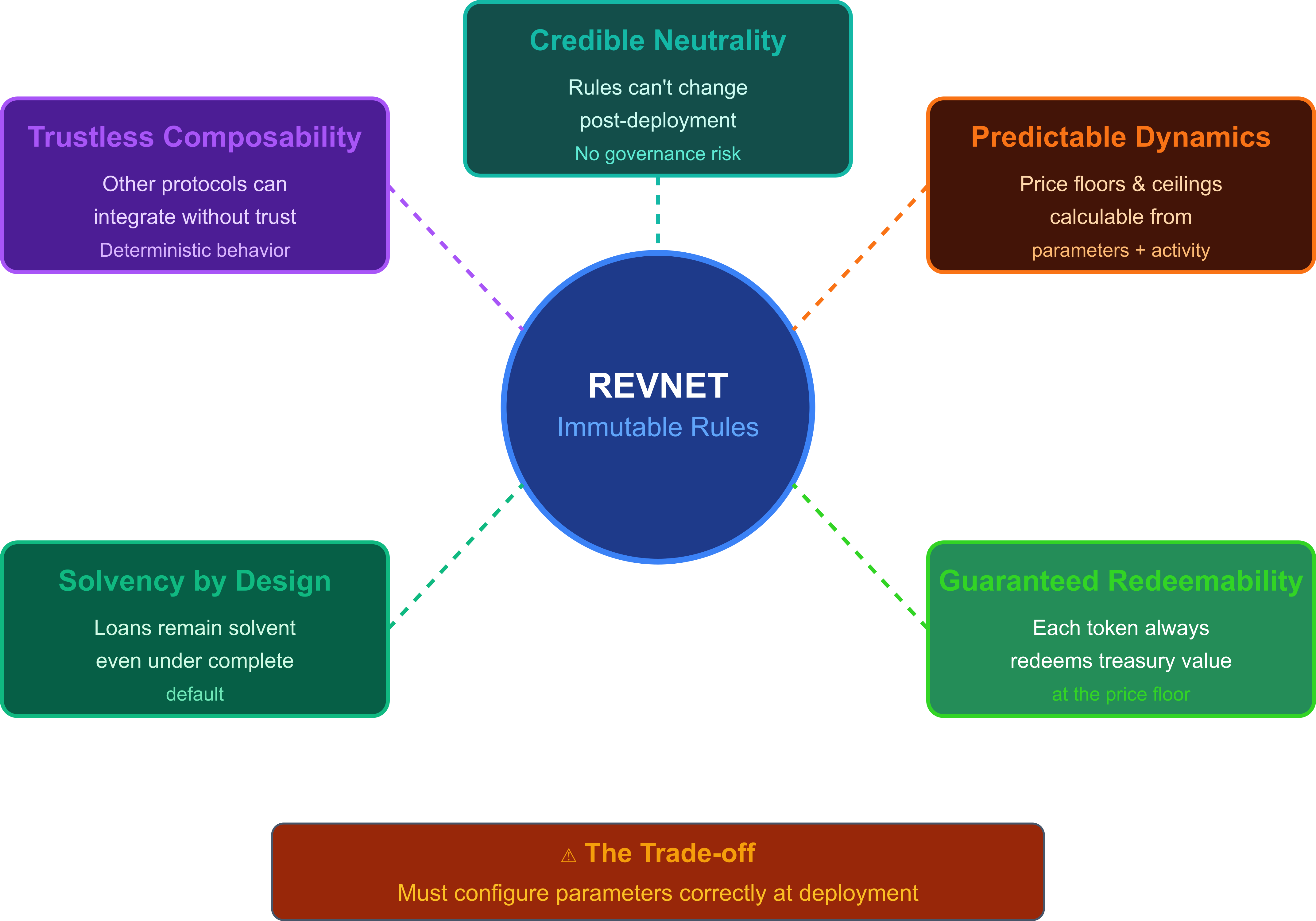
Credible Neutrality: Because rules cannot be changed post-deployment, participants know exactly what they're getting into. A coffee shop owner can't suddenly dilute customer tokens. A token launch can't introduce unexpected vesting schedules. The system is genuinely "set and forget", eliminating ongoing operational overhead while providing mathematical guarantees about how value flows.
Predictable Dynamics: The price corridor, floor appreciation rate, and loan economics are all calculable from the parameter configuration and activity patterns. This makes Revnets particularly suitable for applications where predictability matters: business revenue modeling, treasury management, or any scenario where participants need to understand economic outcomes before committing.
Composability Without Trust: Because Revnet behavior is deterministic, other protocols can integrate with them without requiring trust or social coordination. A lending protocol can precisely calculate collateral risk. A DEX can model liquidity depth. A derivative platform can price options. The immutability that constrains the Revnet creator simultaneously enables trustless composability.
Solvency by Construction: Unlike lending protocols that require liquidation mechanisms, oracles, and active management, Revnet loans are designed to remain solvent even under complete defaults. The same determinism that governs issuance and redemption ensures the loan mechanism cannot create undercollateralized positions. This isn't operational resilience: it's a mathematical property of the system.
However, these advantages come with a critical constraint: success depends on proper tuning of the parameters at launch, tailored to the specific application Because there is no governance mechanism for post-deployment adjustment, any misaligned cash-out tax, issuance schedule, or revenue split will permanently shape the system's dynamics.
A Concrete Example: The Coffee Shop Revnet
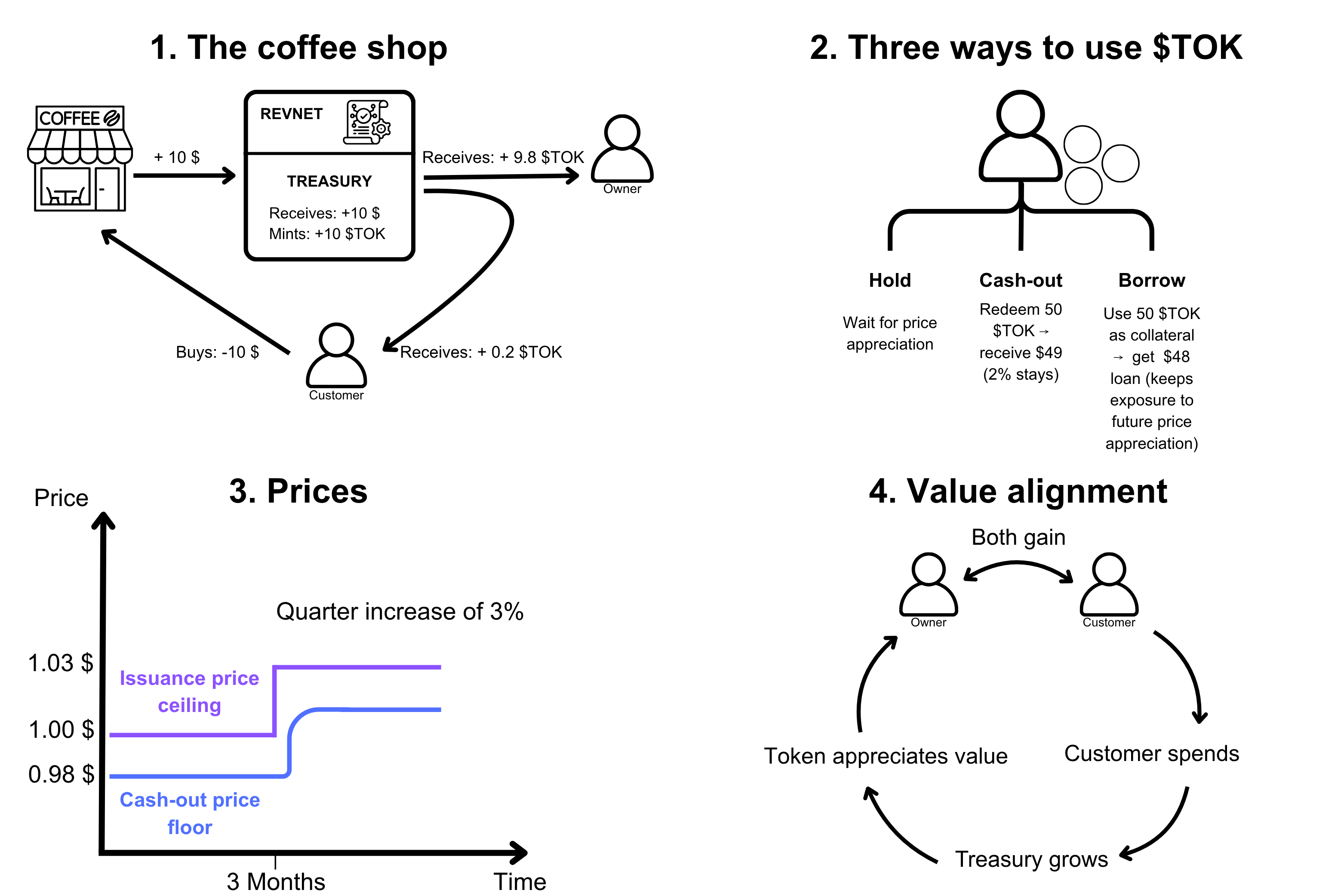
To illustrate how Revnets work in practice, consider a coffee shop implementing a Revnet-based loyalty program. The owner deploys a Revnet with the following configuration:
- Issuance price: $1.00 per token, increasing by 3% quarterly
- Revenue split: 98% to owner, 2% to customers
- Cash-out tax: 2%
Every time a customer spends $100 at the shop, the Revnet mints 100 tokens. The owner automatically receives 98 tokens as revenue (representing their claim on the $100 now in the treasury), while the customer gets 2 tokens as cashback. The key insight: the full $100 remains in the treasury, backing all issued tokens.
Customers have three options with their accumulated tokens:
- Hold them: As the business grows and more revenue flows in, the treasury-to-supply ratio increases, meaning each token can redeem more value over time.
- Cash out: A customer with 50 tokens could redeem them for approximately $49 (accounting for the 2% cash-out tax). The remaining $1 stays in the treasury, slightly increasing the backing for all remaining token holders, including the owner's 98% share.
- Borrow against them: Instead of holding or cashing out, a customer could use 50 tokens as collateral for a ~$48 loan. This allows them to access cash today, while maintaining their exposure to the coffee shop's future growth. If the business thrives and token value appreciates, they can repay the loan to reclaim their full token position and benefit from that appreciation. If they don't repay, it is not a problem. The loan was overcollateralized and liquidated at emission: the system remains solvent.
For the owner, this structure creates several advantages: they receive token-denominated revenue that appreciates with business growth, and their large position benefits from every customer redemption through the cash-out tax. Crucially, both loans and cash outs give them flexible access to revenue: they can extract value when needed or hold tokens to benefit from future growth. The system requires no governance decisions or DAO management because rules execute automatically once set.
For customers, tokens provide genuine utility: cash out accumulated value, borrow against it, or hold as the business grows. The backing ratio ensures tokens always have redeemable value tied to actual business performance, not speculation.
Importantly, this structure aligns incentives: owners and customers hold the same token, benefiting from the same appreciation mechanics. Both share upside from business success.
This same mechanism, with different parameters, can serve entirely different purposes: venture funding, creator monetization, token launches. The flexibility comes from how the seven parameters interact to create distinct economic regimes.
Key Findings for Investors
Our technical analysis reveals several properties that make Revnets distinct from traditional token models. These aren't theoretical claims but rather mathematical guarantees that emerge from the system's structure.
Activity-Driven Value Accrual: The cash-out price defines the price floor. This increases through most forms of network activity. When new tokens are issued above the current floor price, the treasury grows faster than supply, raising the backing ratio. When users redeem tokens, the cash-out tax ensures treasury depletion occurs slower than supply reduction, again lifting the floor. Completed loan cycles also increase the floor because the prepaid fees are recycled into the system. Even loan defaults strengthen the floor: the borrowed funds leave the treasury, but the collateral tokens are permanently burned, improving the backing ratio for remaining holders. The one exception is pre-scheduled token releases (auto-issuances), which increase supply without corresponding treasury additions and mechanically dilute the floor. This means that in systems with genuine activity, the floor price has structural upward pressure rather than relying purely on speculative demand.
Tunability of the Issuance Price: The tunable issuance schedule defines a price ceiling. This is not a limitation but a design choice. Unlike the floor, which rises mechanically with network activity, the issuance price evolves over time according to the issuance schedule set at deployment. This makes it a kind of monetary policy lever for the system. A project seeking predictability and transactional stability can adopt a flat or gently rising issuance price, anchoring confidence and encouraging token circulation. Conversely, a network aiming for rapid growth or speculative engagement can set an aggressively rising or unbounded price, amplifying scarcity and rewarding early participation. Between these extremes, periodic or stepwise issuance schedules create rhythm and momentum around fundraising cycles. In every case, the issance price, i.e. the price ceiling, defines how the system expresses growth over time: a tunable vector for shaping capital formation, liquidity dynamics, and investor expectations.
Guaranteed Access to Capital: There are no conditions under which circulating tokens cannot redeem their proportional share of the treasury. This isn't an operational guarantee but a mathematical property of the redemption curve: when applied to the full remaining supply, it always returns exactly the remaining treasury balance. This holds regardless of how many loans are outstanding or what sequence of operations has occurred. Moreover, later redeemers benefit from earlier ones through the cash-out tax. Each exit leaves a portion of value behind, increasing the per-token backing for those who remain. During periods of uncertainty when some participants choose to exit, those exits mechanically strengthen the floor for those who stay.
Loan Solvency Under All Conditions: The loan mechanism cannot produce undercollateralized debt. Collateral is burned at loan origination, and the borrowable amount is always less than what that collateral could redeem. The gap between these values (the overcollateralization margin) depends on the cash-out tax and is always positive. If a borrower never repays, those tokens remain burned while the treasury retains whatever funds weren't borrowed. This means loan defaults actually improve the system's backing ratio rather than threatening it. The mechanism eliminates traditional liquidation risks, oracle dependencies, and cascade failures that plague other lending protocols.
Parameter Interdependencies: The seven parameters don't operate independently. A high cash-out tax increases per-exit floor appreciation but also raises the growth rate needed to make loans attractive. Aggressive issuance price increases can rapidly expand the treasury during high-demand periods but risk creating "runaway" conditions where the ceiling escapes market reach, routing all purchases through secondary markets, halting issuance and potentially degrading liquidity quality. Revenue splits determine not just value distribution but also effective taxation and trading incentives. All this makes initial calibration crucial, since parameters are immutable post-deployment.
These properties suggest Revnets could function as a new kind of economic primitive: one where value accrual is mechanically tied to usage rather than governance decisions or speculative narratives. The price floor provides quantifiable downside protection that strengthens with activity, while the ceiling can be tuned to match different risk-reward profiles. However, this determinism cuts both ways. Systems must be correctly parameterized for their expected activity patterns, and there's no governance mechanism to course-correct if initial assumptions prove wrong.
Guidance for Founders -- Three Archetypal Applications
The immutability of Revnet parameters makes initial configuration critical. Unlike governance-based systems where parameters can be adjusted post-launch, Revnets require getting the design right at deployment. The presence of seven adjustable parameters makes Revnets remarkably flexible. The same underlying mechanism can be tuned to serve dramatically different economic purposes.
To map this design space, we identified three archetypal configurations, each optimized for distinct use cases and participant expectations. These archetypes are not rigid categories but rather reference points that demonstrate how parameter choices shape system behavior. In practice, many Revnets may blend characteristics from multiple patterns or occupy intermediate positions in the parameter space.
Choosing Your Revnet Archetype: TL;DR for Founders
Before diving into finer details, it's useful to understand at a glance how the three archetypes behave in practice. Each configuration represents a distinct economic regime, defined entirely by immutable parameter choices. The table below summarizes empirically validated ranges from our simulations, providing a quick reference for founders calibrating their own Revnet.
| Parameter | Token Launchpad | Stable-Commerce | Periodic Fundraising |
|---|---|---|---|
| Revenue Split | 10–20% | 95–98% | 40–50% |
| Cash-Out Tax | 20–25% | 2–8% | 8–20% |
| Issuance Growth | +20–30% per week | +2.95% per quarter | +40–50% per round |
| Floor Volatility | 0.15% | 0.02% | 0.11% |
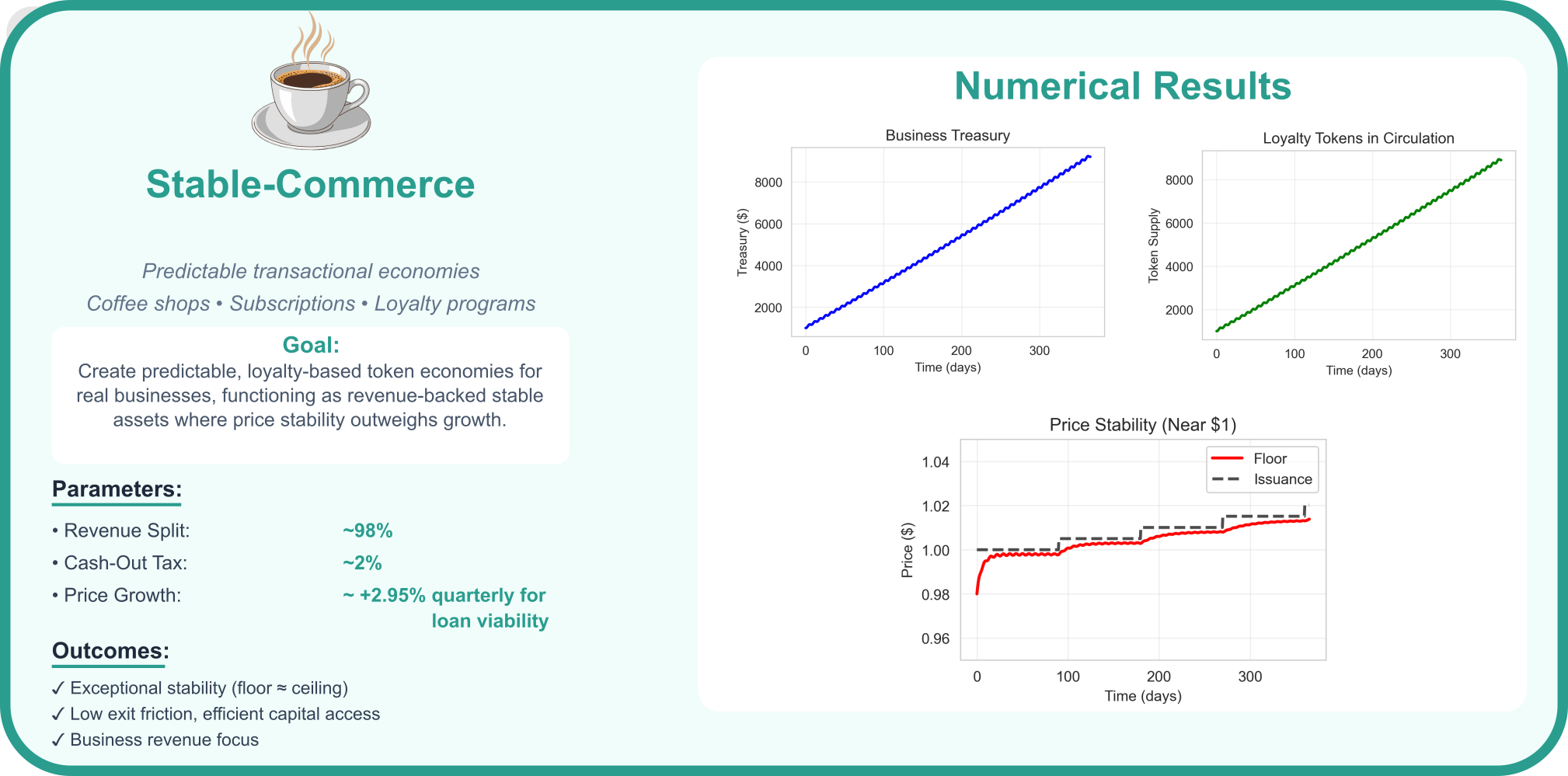
| Floor Growth | +82% / 180d | +2.3% / yr | +61% / 180d |
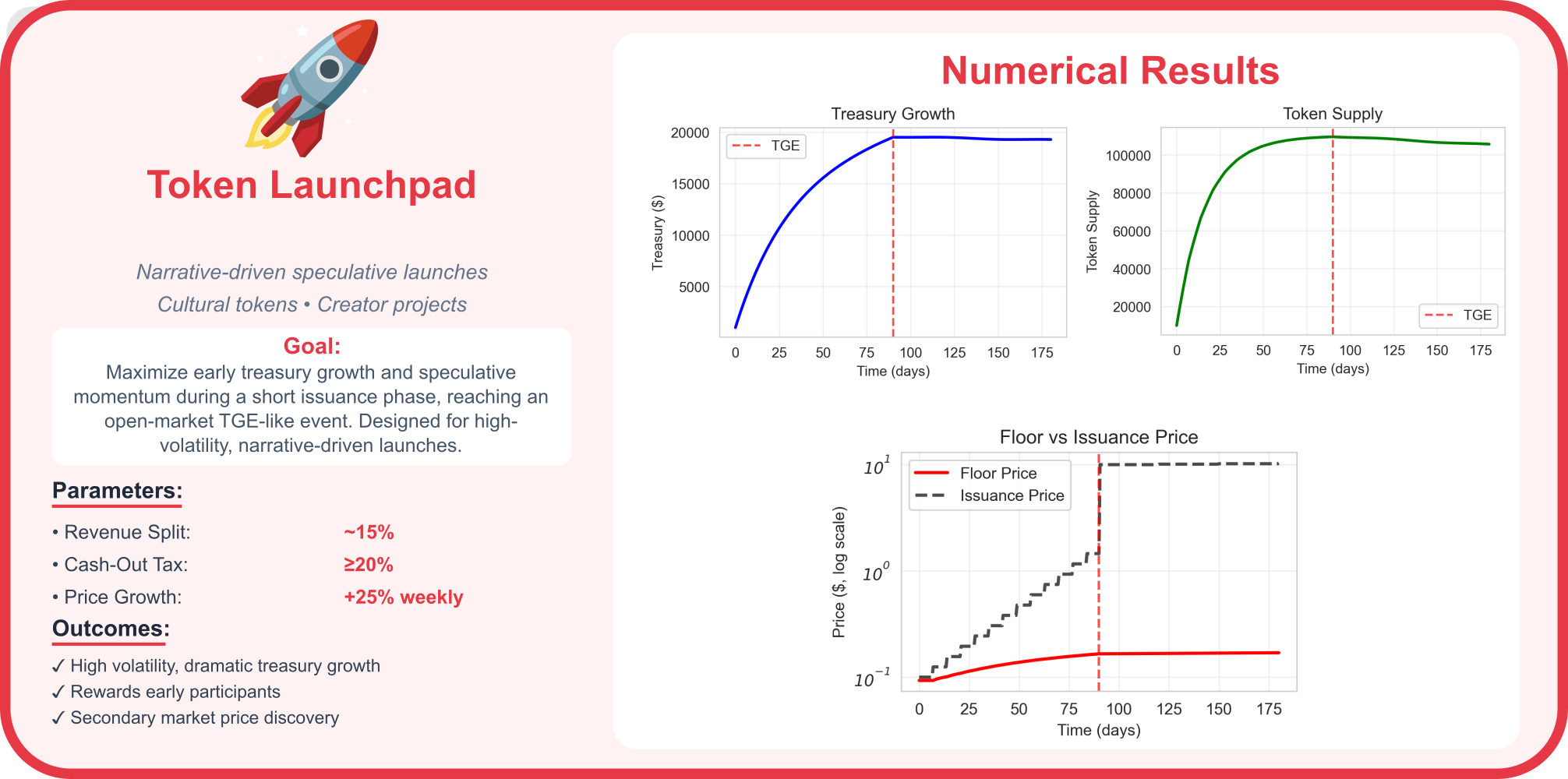
| Treasury Growth | +1,820% / 180d | +368% / 180d | +371% / 180d |
| Supply Growth | +952% | +357% | +192% |
Token Launchpad
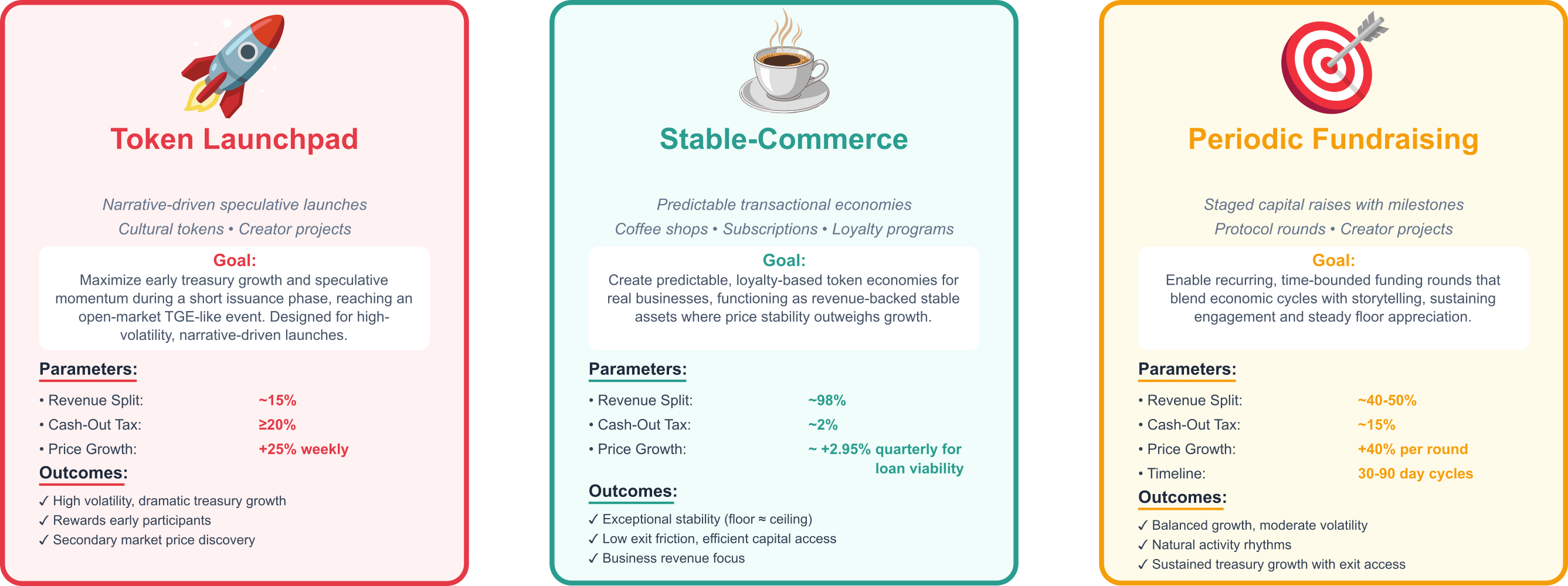
Who it's for: Projects designed for narrative-driven, speculative communities where issuance occurs over a short period before transitioning into a fixed-supply open-market trading with unbounded price ceiling. It suits high-momentum launches such as cultural tokens or early-stage projects where rapid treasury growth and liquidity bootstrapping are prioritized over long-term stability. Think early-stage crypto protocols, creator launches, or any scenario where the goal is to quickly establish a large treasury and active secondary market.
Core characteristics: An initial issuance period followed by an aggressive increase in the issuance price (e.g., +25% weekly) creating urgency and rewarding early participants. High cash-out taxes (≥20%) discourage redemptions during the raise, preserving capital for post-launch liquidity. Moderate revenue splits (~15%) allow broad token distribution to participants rather than concentration with founders. After the initial issuance period, the ceiling price typically rises rapidly towards infinity, halting new primary issuances and shifting all activity to secondary markets.
Economic regime: This configuration produces high volatility but dramatic treasury growth during the issuance phase. The aggressive ceiling and high exit costs push participants toward secondary market trading rather than redemption, creating market-driven price discovery. The system deliberately concentrates capital formation in a short window, then transitions to letting external markets determine valuations.
Stable-Commerce
Who it's for: Businesses seeking predictable, transactional token economics without speculation. The coffee shop example above fits this pattern, as would subscription services, loyalty programs, or any commerce application where price stability matters more than explosive growth.
Core characteristics: Nearly flat issuance prices with minimal periodic adjustments (e.g., +0.5% quarterly) provide stability. Very low cash-out taxes (~2%) enable efficient capital access without creating significant exit friction. Extremely high revenue splits (~98%) route most value to business operators while giving customers modest cashback. The goal is to make tokens function more like stable digital receipts than speculative assets.
Economic regime: This configuration produces exceptional price stability, with the floor tracking very close to the ceiling. If the business wants to rationally access the capital via loans, a careful calibration of the minimum price issuance growth rate needed to make loan repayment economically rational. From our analysis an increase of at least ~2.95% suffices.
Periodic Fundraising
Who it's for: Projects that benefit from discrete funding cycles with clear narrative moments. Think protocols raising capital in distinct "rounds," creator projects with periodic milestones, or any scenario where staged funding provides natural marketing and community engagement opportunities.
Core characteristics: The system operates in defined time-bounded stages (e.g., 30-90 day cycles), with stepwise price increases between stages (e.g., +40% per round). Moderate revenue splits (~40-50%) balance distribution between new participants and existing holders. Mid-range cash-out taxes (~15%) allow exit accessibility while creating meaningful floor appreciation. Each stage functions as a mini-fundraise with built-in scarcity and time pressure.
Economic regime: This configuration balances growth with stability. The discrete stages create natural rhythms for activity, while the moderate parameters prevent extreme volatility in either direction. The system can sustain positive treasury growth even during periods when redemptions exceed new issuance, as the cash-out tax ensures each exit leaves value behind.

Key considerations for Founders
These three archetypes demonstrate how a Revnet produces distinct behaviors through parameter selection alone. A Token Launchpad prioritizes momentum and capital concentration. Stable-Commerce prioritizes predictability and low friction. Periodic Fundraising creates structured growth rhythms. Understanding these patterns helps both investors evaluate what a given Revnet is optimized for, and founders select parameters aligned with their actual objectives. Our theoretical and numerical analysis suggests several key considerations that need to be accounted for when deploying a Revnet.
Cash-Out Tax Regimes: The cash-out tax shapes the fundamental behavior of your Revnet. Low taxes (under 8%) provide efficient capital access and are appropriate when you expect continuous activity that can sustain steady floor growth through volume rather than per-exit appreciation. This works well for Stable-Commerce applications where price stability matters more than rapid appreciation. Moderate taxes (8-20%) balance exit accessibility with meaningful floor appreciation per redemption. This range suits systems where you want exits to strengthen remaining holders without making capital access prohibitively expensive. High taxes (above 20%) strongly discourage exits and maximize per-redemption floor growth, making them suitable for Token Launchpad scenarios where you want to preserve capital for post-launch liquidity and incentivize secondary market trading over redemptions. However, higher cash-out taxes create a trade-off: while they increase floor appreciation per exit, they also raise the growth threshold needed to make loan repayment rational.
Note: Around 40% cash-out tax, liquidity preferences shift. Below this threshold, participants in periods of low confidence will exit via redemption. Above it, particularly for larger holders, loans can provide access to more capital upfront. However, higher taxes also increase the appreciation threshold needed to make loan repayment worthwhile. If the system doesn't generate sufficient growth, borrowers may rationally take loans without repaying them. The system remains solvent in both scenarios, but the behavioral pattern signals whether your parameters match your growth reality.
Revenue Split Considerations: The split parameter determines how newly issued tokens are distributed. Low splits (under 20%) allow buyers to access more tokens directly, reducing effective taxation and encouraging broad distribution during issuance phases. High splits (above 80%) route most tokens to designated recipients, such as business owners in commerce applications, while providing modest cashback to customers. This creates stable revenue capture for service providers. Moderate splits (40-50%) balance value distribution between new participants and existing stakeholders, creating cooperative dynamics suitable for Periodic Fundraising where you want each round to reward both new contributors and long-term holders.
Issuance Price Growth: The issuance price acts as a price ceiling, and its trajectory fundamentally shapes system dynamics. Flat or minimal growth (under 1% quarterly) provides stability but requires careful consideration of loan viability. Our simulations show that Stable-Commerce systems need at least +2.95% quarterly growth to make loan repayment attractive compared to immediate redemption. Without this minimum growth, the system defaults to redemption-only liquidity access. Moderate growth (2-10% per period) sustains loan activity while maintaining reasonable stability. This range works for systems with steady organic adoption. Aggressive growth (above 20% per period) creates urgency and momentum during issuance phases, suitable for Token Launchpad configurations, but requires careful timing of the transition to secondary markets. When ceiling growth outpaces market prices, the system enters a "runaway" regime where purchases route through secondary markets rather than primary issuance, halting the token supply increase. Some Revnet designs, intentionally create this condition to enable unbounded upside price discovery. However, if market traction is weak, participants who lose confidence can exit, and the resulting redemptions may degrade the secondary market liquidity even as they strengthen the floor for remaining holders.
Auto-Issuance Caution: Pre-scheduled token releases to team members, investors, or other stakeholders always dilute the floor price. These releases increase circulating supply without adding to the treasury, mechanically reducing the backing ratio. Our simulations show the impact is proportional to the release size relative to existing supply. Large auto-issuances can significantly undermine floor credibility regardless of when they occur. Autoissuances should be as small as possible and timed after periods of strong organic activity.
The parameter space is large, and our three design patterns represent validated configurations rather than the only viable options. However, they illustrate an important principle: parameters must be internally consistent and matched to realistic activity assumptions.
Conclusions
Revnets represent an approach to tokenizing revenue where deterministic rules replace governance decisions. Our analysis demonstrates that these systems can create predictable economic dynamics: a predefined issuance monetary policy that generates a time-evolving price ceiling, a price floor that rises with activity, guaranteed redeemability of the token under all conditions, and loan mechanisms that remain solvent even under mass defaults. The price corridor structure provides a framework for thinking about token value that differs from purely speculative models.
For investors, Revnets offer tokens with mathematically provable backing floors and mechanical value accrual tied to usage. The downside protection strengthens as the system is used, and the solvency guarantees mean later participants benefit from earlier ones through the cash-out tax structure. Our numerical simulations demonstrate that different configurations can produce different risk-reward profiles: from high-volatility, high-growth Launchpad dynamics, to stable commerce applications.
For founders, Revnets provide a template for creating autonomous token economies, but success depends critically on parameter calibration. The immutability that eliminates governance risk also means you must correctly anticipate how your system will be used. Our three design patterns demonstrate that the same mechanism can be tuned for significantly different outcomes, and the key is ensuring parameter choices are internally consistent and matched to realistic activity assumptions. A Stable-Commerce configuration requires at least +2.95% quarterly growth to maintain loan viability. A Launchpad needs sufficient initial momentum to support its aggressive ceiling trajectory. A Periodic Fundraising system must balance stage durations with community engagement rhythms.
Our complete technical findings, including the mathematical framework, simulation methodology, and detailed parameter sensitivity analysis, are available in three papers: Cryptoeconomics of Revnets, Revnet Parameters Analysis, and Revnet Value Flows as a Continuous–Time Dynamical System . These provide the formal proofs and computational results underlying the guidance presented here.
Revnets may not suit every use case, and their immutability makes them unforgiving of misconfiguration. But for applications where deterministic, governance-free value accrual matters, where credible commitment to economic rules provides more value than adaptive flexibility, they offer a valuable mechanism with well-understood properties. The numerical results validate that when parameters are correctly calibrated, Revnets can sustain treasury growth, floor appreciation, and loan viability across diverse economic conditions and activity patterns.
Discuss This Article With AI
Get instant analysis and insights from leading AI assistants
How We Can Help
Interested in similar solutions for your project? Explore our related services: