The Gamma Upgrade Retrospective: How TIG and CryptoEconLab are Pioneering Mission-Aligned Tokenomics





Key Takeaways
- •The Gamma Upgrade introduces a vault-based distribution mechanism where newly minted tokens are released proportionally to network milestones (new challenges added), aligning token distribution with measurable protocol progress rather than unconditional work.
- •By using an exponential Gamma function that exhibits diminishing returns and bounded output, the mechanism prevents market oversupply during slow growth periods while accelerating rewards during high engagement, creating clear targets that rally community contribution.
- •Mission-aligned tokenomics through the Gamma Upgrade addresses both impact alignment (rewarding verified progress) and sell pressure (reducing reflexive token sales from miners) while maintaining original token supply commitments and extensibility for future metric incorporation.
The Gamma Upgrade Retrospective: How TIG and CryptoEconLab are Pioneering Mission-Aligned Tokenomics
The Innovation Game (TIG) has an ambitious vision: to advance the state of the art in computational methods by incentivizing Algorithmic Innovation. Our work with the TIG team focused on a simple but critical question: How can a protocol’s tokenomics directly serve its core mission?
The answer is the Gamma Upgrade, a mechanism implemented three months ago to align token distribution with meaningful progress. Today, the results are clear. The protocol is attracting cutting-edge problems—from hypergraph partitioning to novel zero-knowledge witness generation—and is entering a new phase of sustainable growth. Supported by mission-aligned tokenomics, a scheduled halving, and major exchange integrations, TIG is proving that a protocol’s economy can be its most powerful tool for scientific advancement.
In this blog post, we will present a brief overview of our collaboration with TIG, seeking to refine mission-aligned tokenomic mechanisms. Let’s start by adding some context, describing the state of the TIG before the Gamma Upgrade.
The Challenge: Supply Emission for Impactful Progress
TIG's original token distribution rewarded work, but this incentive was unconditional on actual downstream impact. For example, innovators could expend resources without hitting the milestones that accurately reflect network progress.
Compounding this issue, the Proof-of-Work model required miners to sell tokens to cover operational costs. This created a cycle of sell pressure that was unrelated to the utility or success of the network.
These two issues created a clear opportunity: to refocus emissions on verified impact while simultaneously reducing reflexive sell pressure.
Taking a deeper look at the impact alignment challenge, the original mechanism did not take into account the state of the network. For instance, when a new challenge is presented to the network, T tokens distributed at every epoch among n challenges are now allocated among n+1 challenges.
This means that as the number of challenges increases, the size of the pie decreases. This resulted in (i) a disincentive to join the network and (ii) lower long-term utility for TIG, since their core goal is to create an incentive environment for solving humanity’s most challenging problems.
Put differently, the emission rate was not sensitive enough to the protocol's mission. We needed a system that could reward the network during periods of high engagement while protecting it during lulls.
Our Solution: The Gamma (Γ) Upgrade
Working with TIG Labs, CryptoEconLab helped reimagine token distribution through the Gamma Upgrade, a goal-oriented distribution mechanism (see, here, for example). We recommended to preserve the original minting schedule M(t), while introducing a vault-based system where tokens only release when the protocol achieves measurable milestones.
In this approach, the token distribution is modified, however the original token creation schedule remain unchanged.
The total number of tokens minted over time, defined by the function M(t), remains exactly as promised, however, instead of being released directly to participants, newly minted tokens, ΔM(t), are first deposited into a secure protocol vault.
These tokens are then released from the vault based on the protocol achieving a specific, measurable milestone: adding a new challenge to the network. The flow of these tokens is controlled by a rate-limiting function we call Gamma, or Γ(⋅), which acts like a faucet, as illustrated in the diagram below.
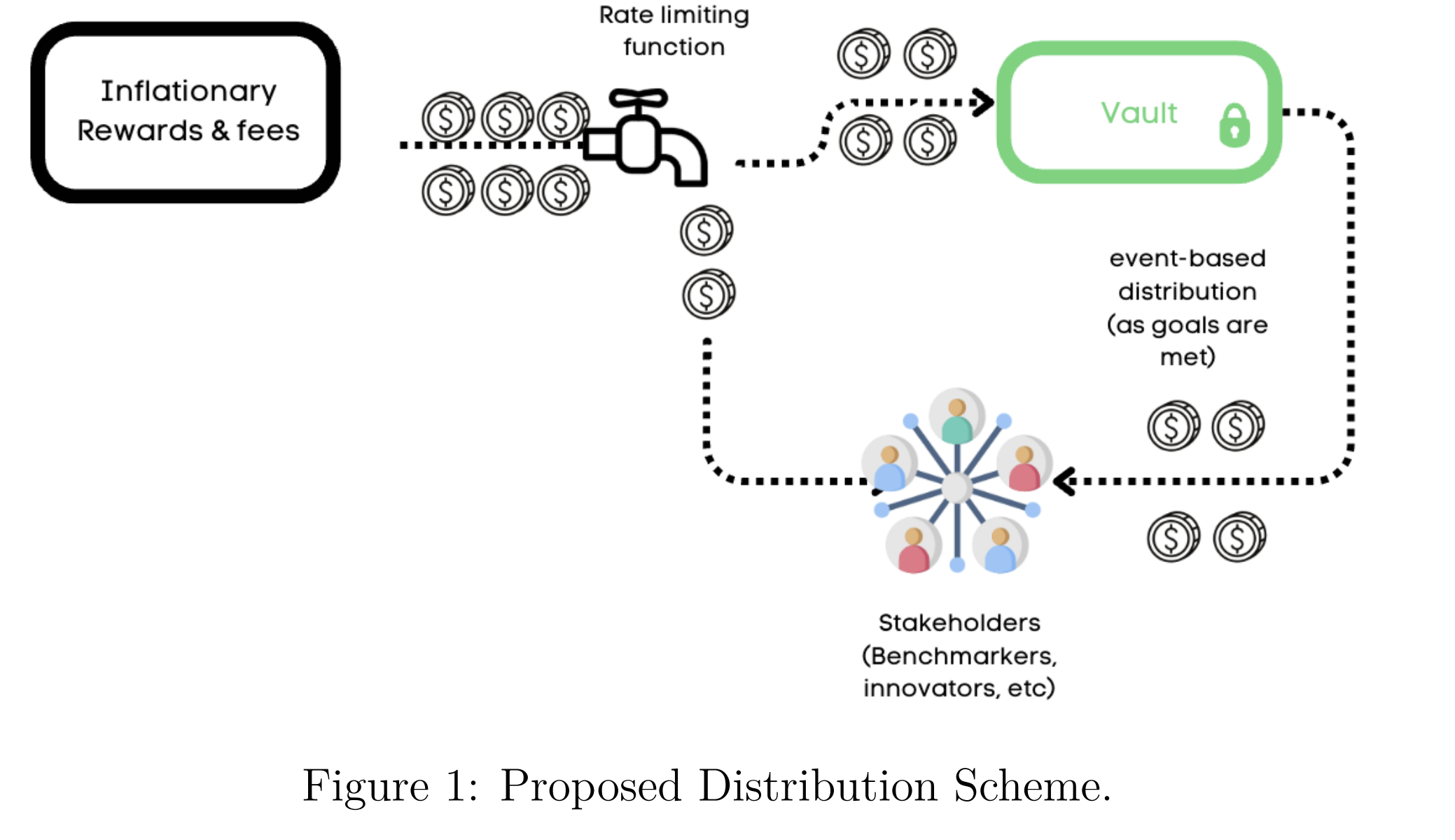
The effectiveness of this mechanism hinges on a single, powerful metric: the number of challenges posted to the protocol. This metric was selected as the ideal proxy for the protocol's long-term well being because it is directly related to TIG's core goal, is difficult to manipulate due to a rigorous approval process, and reflects the kind of breakthroughs that drive the protocol's value.
The distribution in any given period is then calculated as:
Here, Γ is a value between 0 and 1 that is determined by the number of challenges. When the number of new challenges is low, Γ is also low, and only a small fraction of the newly minted tokens are released from the vault. When the protocol sees a surge in new challenges, Γ increases, allowing for a more generous distribution of tokens.
Designing the Right Incentives with
The effectiveness of this entire system hinges on the mathematical properties of the Γ(⋅) function. In our proposal, we outlined several key characteristics to ensure the system is fair and robust:
- Monotonicity: More progress leads to more rewards. Therefore, as the number of challenges n increases, the fraction of unlocked tokens Γ(n) should also increase or stay the same.
- Diminishing Returns: The marginal benefit of each new challenge should gradually decrease. This encourages consistent, early contributions and prevents a single large player from exhausting the vault's rewards too quickly.
- Bounded Range: The function's output must be capped between 0 and 1, ensuring that the protocol never distributes more tokens than have been minted.
As shown in the figure below, several mathematical curves—such as Logistic, Exponential, or Bounded Power functions—satisfy these properties. The choice among them depends on the specific incentive profile the community wants to create. For instance, a logistic curve creates a distinct "adoption" phase where rewards accelerate rapidly, while an exponential curve provides a smoother, more gradual release.
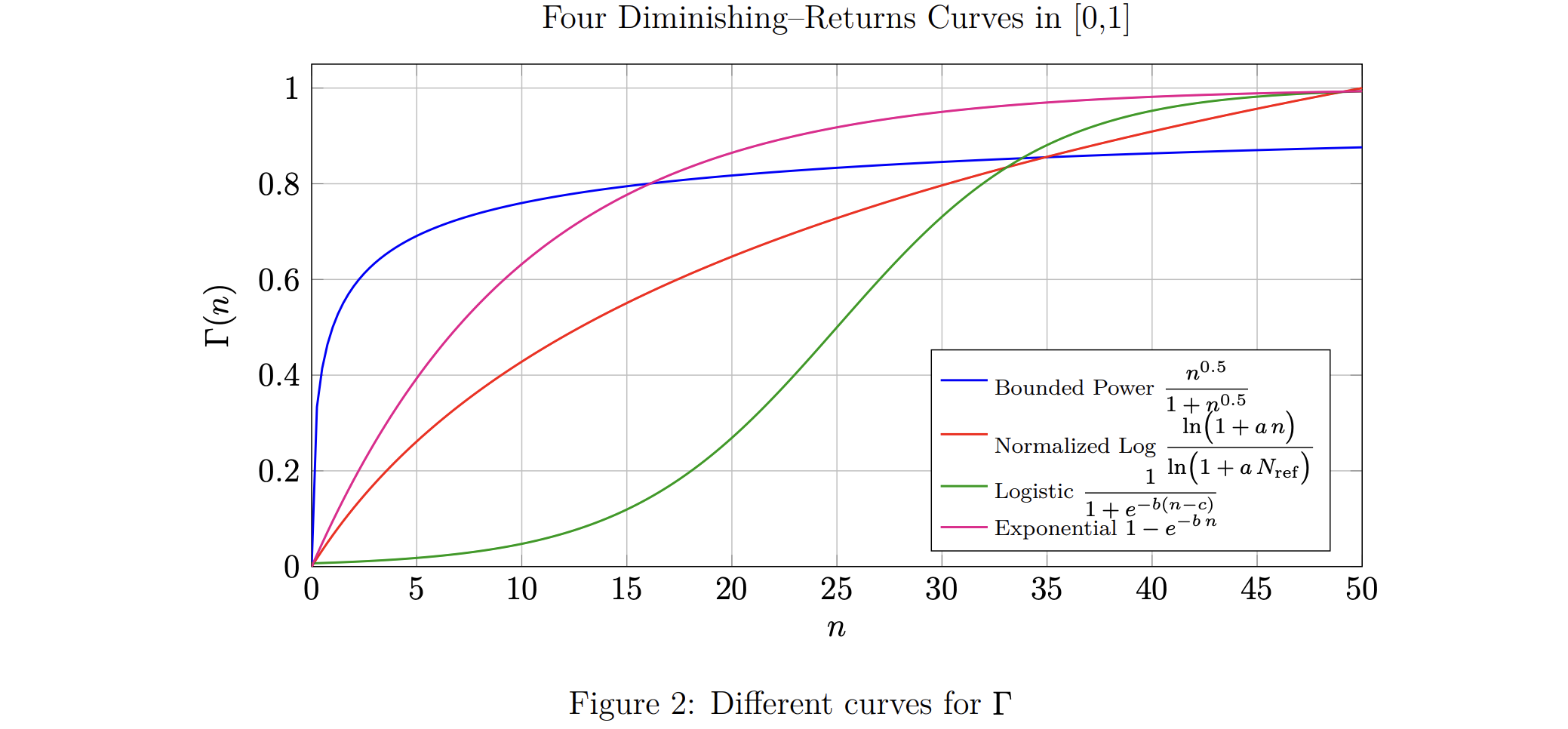
After several in-depth analysis and simulations, we proceeded with exponential family of Γ(⋅)-functions. Notice that by doing so we avoid moving too slow (e.g.m logistic), or too fast, too early, as the bounded power. Some of the UQ-robust, Monte Carlo Simulations we carried as part of our analysis are shown below.
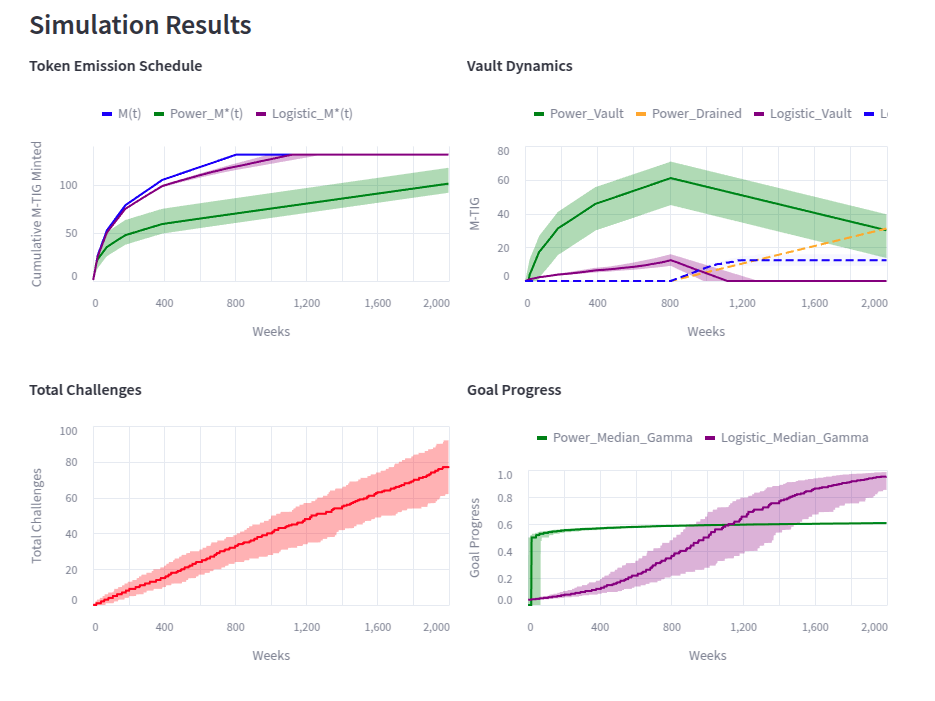
By doing this, the distribution becomes more mission aligned and alleviates the issues initially discussed. More precisely, it offers several powerful advantages:
- Maintains Commitments: It honors the original token supply promises, providing stability and trust.
- Prevents Market Oversupply: In times of slow growth, tokens accumulate in the vault rather than flooding the market, protecting the asset's value.
- Creates Clear Targets: It gives the community a clear, understandable goal to rally behind: submitting high-quality challenges unlocks greater rewards for everyone.
- Extensible by Design: The framework is flexible. In the future, the community could choose to incorporate additional metrics into the function, such as active maintainers or benchmark progress, to further refine the incentive structure.
Conclusion
The success story here is alignment—between distribution and progress, incentives and goals, and individual rewards and collective advancement. This in turn can help balance supply and demand, and lead to a more utility driven protocol. Every token released represents real achievement. Every watt of electricity now contributes to human knowledge. That's a fantastic thing to see.
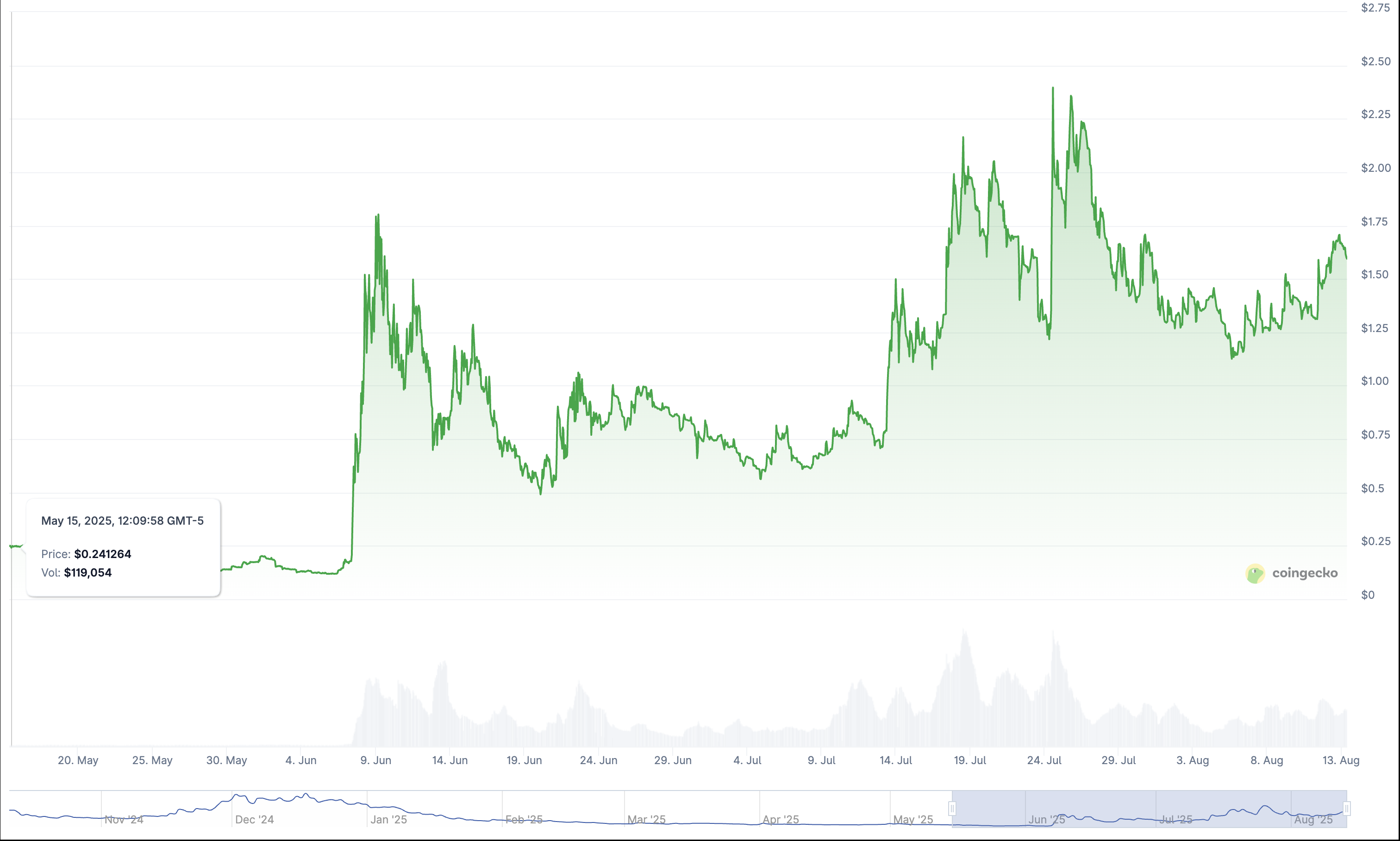
Combined with their halving, and integration with major exchanges, TIG demonstrates the power of cryptoeconomic mechansisms.
Discuss This Article With AI
Get instant analysis and insights from leading AI assistants
How We Can Help
Interested in similar solutions for your project? Explore our related services: