Token Vesting Schedules: What Actually Works





Key Takeaways
- •Vesting schedules are the most critical tool for aligning long-term incentives between founders, investors, and community members. A well-designed schedule prevents premature sell pressure while rewarding sustained contribution to the protocol.
- •Cliff periods serve as commitment gates that filter out short-term actors. The optimal cliff length depends on your development roadmap—typically 6-12 months for team members and 3-6 months for seed investors.
- •Linear vesting creates predictable, manageable sell pressure, while non-linear schedules (back-weighted or milestone-based) can better align unlocks with value creation milestones.
Token Vesting Schedules: What Actually Works
Vesting is one of the few tokenomics parameters that founders can't easily change post-launch. Get it wrong, and you're locked into a schedule that either bleeds value through constant unlocks or creates cliff-day crashes when large tranches hit the market simultaneously.
We've reviewed vesting structures across dozens of protocol engagements. The patterns that work—and the failure modes—are remarkably consistent.
The Function of Vesting
A vesting schedule does three things.
First, it aligns incentives over time. If a founder can dump tokens at TGE, their economic interest diverges from the protocol immediately. A 4-year vest keeps them aligned through the critical growth phase.
Second, it manages supply inflation. Tokens entering circulation create sell pressure. Predictable unlocks let the market price in future supply; surprise unlocks destroy confidence.
Third, it signals commitment. Long vesting periods communicate that insiders believe in multi-year outcomes. Short vesting signals they're optimizing for near-term liquidity.
Anatomy of a Vesting Schedule
Four parameters define any vesting structure:
The cliff period is the initial lockup before any tokens unlock. A 12-month cliff means zero tokens for the first year; if someone leaves at month 11, they get nothing. This filters for genuine commitment.
Vesting duration is total time from grant to full unlock. Team tokens typically vest over 3-4 years; investor tokens over 2-3 years.
Unlock frequency is usually monthly. Quarterly creates larger periodic sell pressure. Continuous (per-block) is elegant but adds implementation complexity.
Unlock shape determines the curve: linear (equal amounts per period), back-weighted (more tokens unlock later), or milestone-based.
What We've Seen Work
Team: 12-month cliff, 36-month linear vest (4 years total)
This mirrors traditional startup equity vesting, which matters because it's familiar to talent coming from Web2. The 12-month cliff covers the period where most early-stage projects fail or pivot dramatically. The 4-year total aligns with typical founder commitment cycles.
Uniswap used 4-year vesting for their team allocation. Filecoin went even longer with 6-year schedules for team and founders.
Seed investors: 6-month cliff, 18-month linear vest (2 years total)
Seed investors take earlier risk and often wait 1-2 years before TGE. Requiring another 4 years of vesting post-TGE makes raises uncompetitive. The 6-month cliff still filters for conviction; the 2-year total balances investor liquidity needs with community protection.
Later-stage investors: shorter terms
Series A and strategic investors have less risk (product is more proven) and typically negotiate 12-18 month total vesting. This is market reality—pushing for longer terms often means losing competitive deals.
Linear vs. Back-Weighted
Linear vesting unlocks equal amounts each period after the cliff.
1M tokens with 12-month cliff and 36-month linear vest:
- Months 1-12: 0 tokens
- Months 13-48: ~27,778 tokens/month
The advantage is predictability. Everyone—holders, traders, protocol teams—can model exactly when supply enters circulation. The disadvantage is that early unlocks happen before the protocol has proven product-market fit.
Back-weighted vesting front-loads the lockup.
1M tokens with exponential back-weighting:
- Year 1: 10% (100K)
- Year 2: 20% (200K)
- Year 3: 30% (300K)
- Year 4: 40% (400K)
This structure better aligns unlocks with expected value creation—more tokens become liquid when the protocol is (hopefully) more mature. The tradeoff: it's harder to attract early employees who want earlier liquidity, and harder to explain to stakeholders.
Linear vesting is common and well understood, but milestone-based unlocking can help projects balance liquidity with progress made on the protocol.
The Mistakes We See Repeatedly
Coordinated cliff dates. When team, seed, and strategic investors all have the same 12-month cliff, you get a massive coordinated unlock event. Several 2021-era protocols saw 30-40% price drops on cliff day. Stagger your cliffs across cohorts.
Large TGE unlocks. Some protocols unlock 15-20% of supply at TGE. This creates immediate sell pressure from everyone who received tokens—advisors selling to cover taxes, investors taking profits, ecosystem recipients converting to stables. Keep TGE unlocks low.
No team departure provisions. What happens when a core contributor leaves at month 18? If unvested tokens don't return to treasury, you've permanently allocated supply to someone no longer building. This must be defined in vesting contracts upfront.
Ignoring downstream effects. Your vesting schedule doesn't just affect your token—it affects every protocol using your token as collateral. Large, predictable unlocks can trigger liquidation cascades across DeFi if your token is widely used in lending markets.
Modeling Before Committing
Before finalizing vesting parameters, model the unlock schedule across scenarios. Our Token Emission Simulator lets you adjust emission rates, vesting periods, and unlock shapes to see how they affect circulating supply over time.
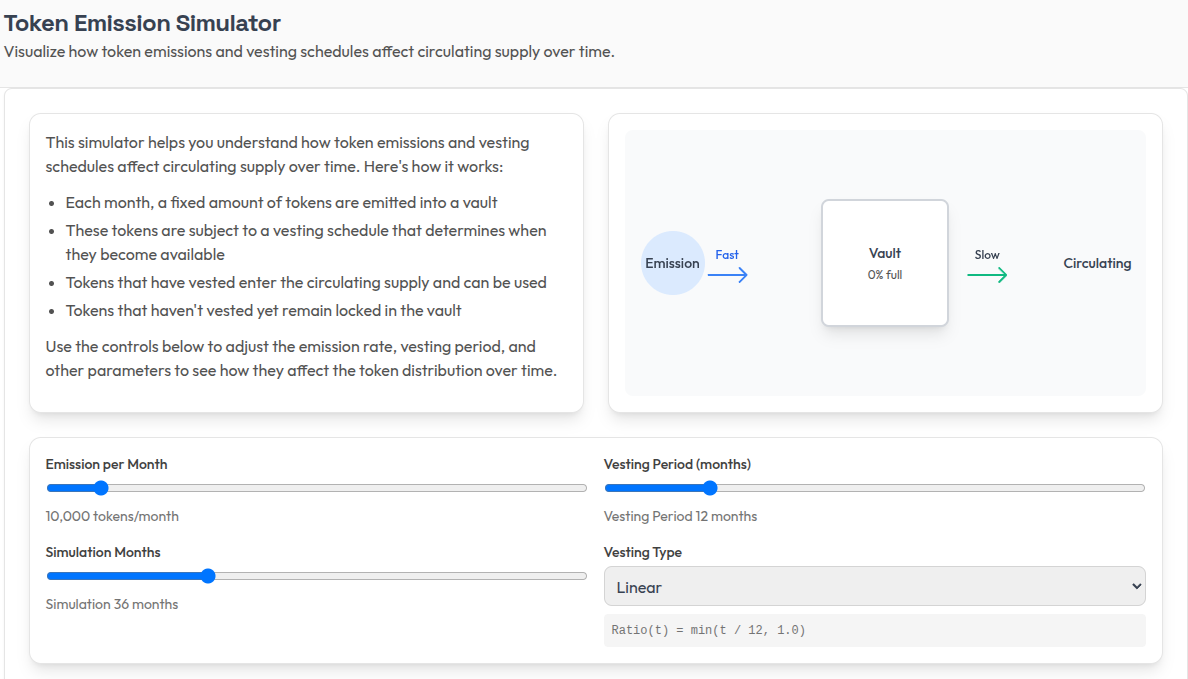
Bull market: Large unlocks during price peaks create sell pressure at the worst time. Will insiders resist the temptation?
Bear market: If token price is 80% down at the 12-month cliff, will team members stay motivated? Some protocols have seen key contributors leave when their unvested tokens went underwater.
Cumulative supply: Plot your total circulating supply over 4 years, including vesting + emissions + ecosystem distributions. If 70% of supply enters circulation in year 1, expect structural sell pressure regardless of protocol performance.
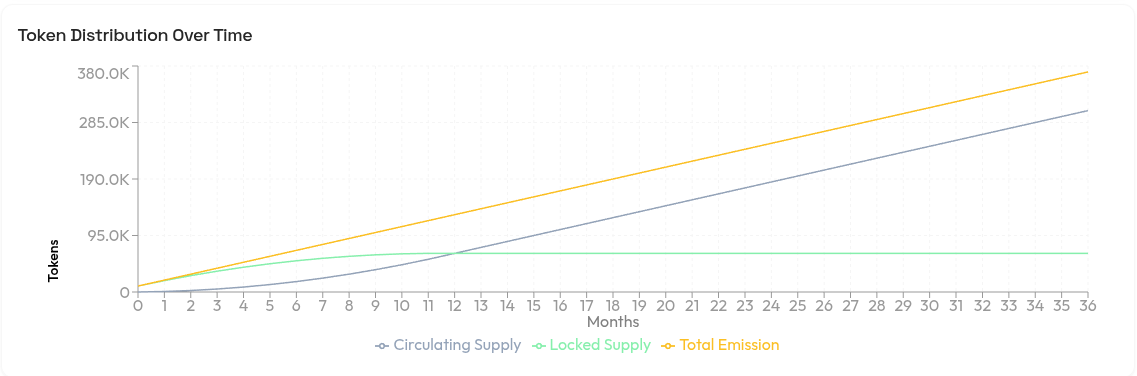
The chart above shows a typical linear vesting scenario: total emissions grow steadily while locked supply peaks around month 12 (the vesting period) before declining as tokens vest into circulation.
Summary
Vesting schedule design is high-leverage because it's immutable. A thoughtful structure aligns incentives for years; a careless one creates predictable failure modes.
The key principles:
- Use cliffs to filter for commitment (12 months for team, 6 months for seed)
- Stagger unlock dates across stakeholder groups
- Consider milestone-based unlocking to align token release with project milestones
- Model the full supply schedule before committing
- Keep TGE unlocks minimal
The best vesting schedules are boring. Simple enough that anyone can understand them. Thoughtful enough that you don't regret them two years later when the market looks completely different.
Need help modeling your vesting schedule? Try our Token Emission Simulator or contact us to discuss your tokenomics design.
Discuss This Article With AI
Get instant analysis and insights from leading AI assistants
How We Can Help
Interested in similar solutions for your project? Explore our related services: