veTokenomics: Why Vote-Escrow Models Took Over DeFi




Key Takeaways
- •Vote-escrow models transform governance tokens from speculative assets into utility tokens by requiring time-locked commitment in exchange for voting power and protocol rewards.
- •The key innovation of veTokenomics is the non-transferable, time-decaying lock that creates genuine skin-in-the-game. Longer locks mean more voting power, aligning voter incentives with long-term protocol health.
- •veTokenomics face challenges including vote-buying through bribes, lock wrapper protocols that restore transferability, and governance capture by large holders—issues protocols must actively design against.
veTokenomics: Why Vote-Escrow Models Took Over DeFi
Curve Finance introduced veCRV in 2020. Within two years, the model spread to Balancer (veBAL), Frax (veFXS), Yearn, and dozens of other protocols. What made this particular tokenomics design so compelling?
The answer lies in a fundamental problem with governance tokens.
The Problem With Standard Governance
Traditional governance tokens suffer from a misalignment: token holders can vote on protocol decisions without bearing the consequences.
Consider: a proposal increases short-term yields at the cost of long-term sustainability. Holders planning to sell next week have every incentive to vote yes—they capture the benefit and exit before the damage materializes. This creates a race to extract value rather than build it.
One-token-one-vote governance also concentrates power among the largest holders, regardless of their time horizon or alignment with the protocol.
The ve Mechanism
Vote-escrow flips this dynamic. The core mechanism:
- Lock tokens for a chosen duration (1 week to 4 years for Curve)
- Receive voting power proportional to both amount and lock duration
- Voting power decays linearly as the lock expires
- Locked tokens are non-transferable
This creates several effects.
Voting power becomes time-weighted. Someone locked for 4 years can have 4x the voting power of someone locked for 1 year with the same token count (the exact multiplier depends on the curve chosen by the protocol). Long-term believers dominate governance.
You actually have skin in the game. If you vote for a harmful proposal, you can't exit—you're locked in to experience the consequences.
And it reduces circulating supply. Locked tokens can't be sold. As of August 2024, approximately 44% of CRV supply was locked as veCRV, removing a significant amount of potential sell pressure.
How veCRV Works in Practice
Curve's implementation set the template:
Locking mechanics: Lock CRV for 1 week to 4 years. Receive veCRV equal to CRV_amount × (lock_duration / 4_years). So 1000 CRV locked for 4 years = 1000 veCRV. Same amount locked for 1 year = 250 veCRV.
Decay: veCRV decreases linearly as the lock approaches expiration. To maintain full voting power, holders must periodically extend their locks.
Gauge voting: veCRV holders vote on "gauge weights" that determine how CRV emissions are distributed across liquidity pools. Pools receiving more votes get more CRV rewards, attracting more liquidity.
This creates the "Curve Wars"—protocols compete to accumulate veCRV voting power to direct emissions toward their preferred pools.
Boost mechanism: LPs can boost their CRV rewards by up to 2.5x based on their veCRV holdings. This creates demand for veCRV beyond pure governance: users want the yield boost.
The Economic Flywheel
When ve-models work, they create a self-reinforcing loop:
- Projects want gauge voting power → they buy and lock tokens
- More locked tokens → reduced circulating supply → price support
- Higher prices → more attractive emissions → more users → more protocol revenue
- Revenue distributed to ve-holders → more incentive to lock
This flywheel drove CRV from a "farm and dump" liquidity mining token to something with genuine economic utility.
Where It Breaks Down
The Bribe Markets
Third-party platforms like Votium and Hidden Hand allow protocols to pay ve-holders directly for their votes. Convex built an empire on aggregating veCRV and selling vote power to the highest bidder.
The result: gauge votes increasingly go to whoever pays the most, not whoever has the best proposal for the protocol. A well-funded project can effectively buy emissions allocation.
This isn't necessarily bad—it creates real yield for ve-holders. But it transforms governance from "what's best for the protocol" to "who's willing to pay for influence."
Liquid Wrappers
Protocols like Convex accept CRV deposits, lock them permanently for veCRV, and issue a liquid wrapper token (cvxCRV). This restores the transferability that ve-models intentionally removed.
As of mid-2024, Convex controlled over 41% of all veCRV. This concentrates governance power in a single protocol and undermines the "skin in the game" premise—you can get ve-token exposure without actually locking.
Governance Capture
ve-models have a rich-get-richer dynamic. Large holders accumulate more voting power, vote for policies benefiting themselves, and compound their position. Over time, this can lead to governance capture where a small group controls protocol direction.
Curve governance is now dominated by a handful of large players: Convex, Yearn, Frax, and a few whales. Whether this is a problem depends on whether those players' interests align with the broader user base.
Design Considerations for New ve-Models
If you're implementing ve-tokenomics, a few things matter:
Lock duration range is critical. Max locks under 1 year may not create meaningful commitment. Max locks over 4 years may discourage participation. The 1-4 year range has proven workable.
For the decay function, linear decay (the Curve model) is simple and predictable. Step functions or no-decay models are alternatives but add complexity without clear benefit.
Pure governance power often isn't enough incentive to lock. You'll probably need additional utility: revenue sharing, boost mechanisms for protocol rewards, fee discounts, or exclusive feature access.
Once your ve-token exists, someone will try to wrap it. You can try anti-wrapper measures—withdrawal penalties, boost mechanics that require personal holding, time-delayed claiming—but there's no perfect solution. Curve couldn't prevent Convex. Your protocol probably can't prevent wrappers either. The goal is making direct locking more attractive than wrapper exposure.
Should You Use ve-Tokenomics?
ve-models work best when:
Governance decisions matter. If your protocol has meaningful parameters to vote on (emission allocation, fee structures, whitelisting), ve-alignment helps ensure voters care about outcomes.
You have ongoing emissions. Gauge voting creates demand for ve-tokens. Without emissions to direct, the incentive to lock weakens significantly.
Long-term alignment is critical. For protocols where short-term optimization can damage long-term health, ve-models filter for participants with multi-year horizons.
ve-models may not fit when:
Governance is minimal. Simple protocols with few governable parameters don't benefit much from complex voting mechanisms.
Users need liquidity. If your user base is primarily short-term, locking requirements create friction without proportionate benefit.
Token utility is elsewhere. If the token's main use is gas payment, collateral, or fee payment, locking reduces utility.
Modeling ve-Dynamics
Before launching a ve-model, understand the expected dynamics:
- What % of supply will realistically lock?
- At what duration distribution?
- How will voting power concentrate over time?
- What bribe rates make vote-buying dominant?
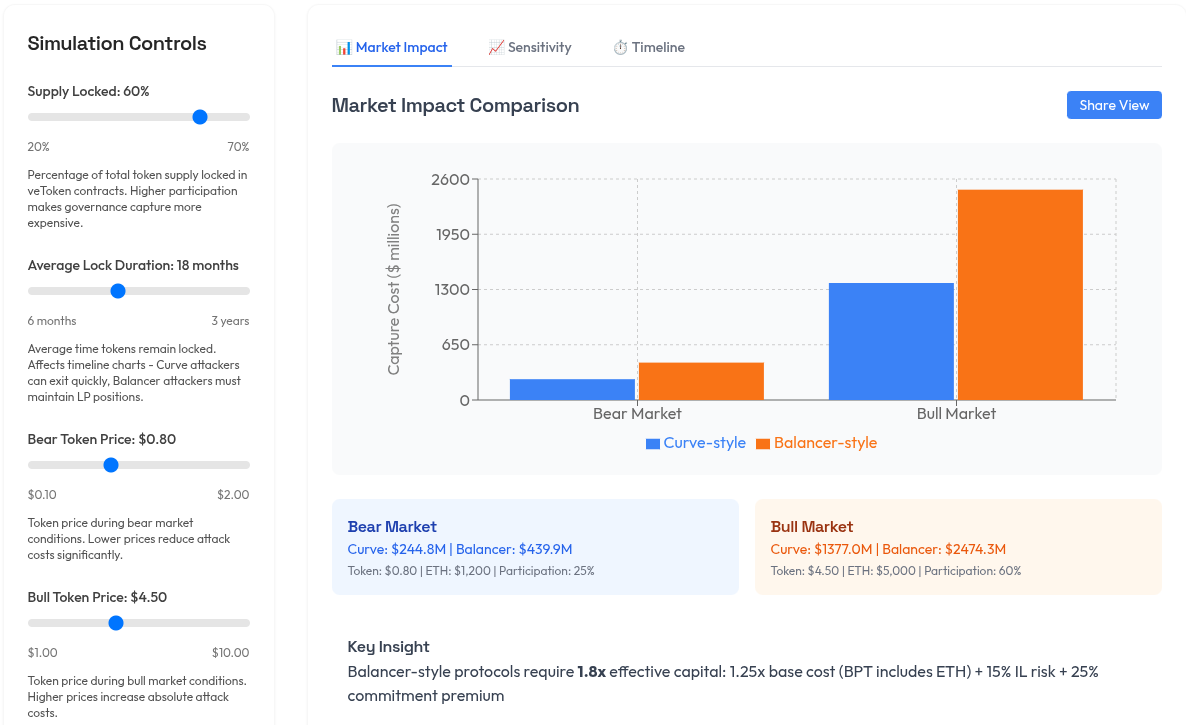
Our veTokenomics Simulator lets you model lock distribution, voting power decay, and governance capture costs across different market conditions. The chart above compares attack costs for Curve-style (pure veCRV) vs Balancer-style (veBAL with BPT requirement) models—Balancer's design requiring LP positions alongside locks makes governance capture significantly more expensive.
Summary
veTokenomics solved a real problem: governance tokens where voters don't bear consequences. By requiring time-locked commitment, ve-models create genuine alignment between voters and protocol outcomes.
The tradeoffs are real—bribe markets, liquid wrappers, and concentration dynamics can undermine the model's benefits. But for protocols where governance matters and long-term alignment is critical, ve-tokenomics remain one of the most effective designs available.
Here's the thing though: ve-models don't eliminate mercenary behavior. They change who the mercenaries are. Instead of farm-and-dump liquidity miners, you get protocols competing for gauge influence. Whether that's an improvement depends entirely on what you're trying to build.
Exploring ve-tokenomics for your protocol? Our veTokenomics Simulator models lock dynamics and governance scenarios. For custom design work, reach out to our team.
Discuss This Article With AI
Get instant analysis and insights from leading AI assistants
How We Can Help
Interested in similar solutions for your project? Explore our related services: